

- Safiu Kehinde
Over the weekend, the Independent National Election (INEC) conducted by-elections for the vacant seats across the states and Federal legislative chambers.
The death of some lawmakers notably, Sen, Ifeanyi Ubah (Anambra), Hon. Justice Azuka (Anambra Assembly), Adewunmi Onanuga (Ogun), and Ekene Adams (Kaduna), amongst others had led to the scheduling of the by-elections held on Saturday across 19 constituencies in 12 states.
Some legislative seats were also rendered vacant on account of the holders’ appointments into other positions.
Such was the case of the Edo State Governor, Monday Okepbholo, who was a senator representing Edo Central senatorial district in the upper chamber of the National Assembly from where he contested election to be elected last year.
However, Saturday’s by-election transcended mere filling of vacant positions. It also stood as a testing for the strength of each of the political parties ahead of the 2027 Presidential election.
Nigerians had, in the past months witnessed political movements and changes across the major parties in the country.
The lingering crisis within the Labour Party and the Peoples Democratic Party (PDP) had resulted in a mass defection to the ruling party, the All Progressives Congress (APC).
With no resolution in sight for both parties, some factional members of the Labour Party and the PDP as well as former APC members established an opposition coalition group with the said objective of ousting the APC-led administration by 2027.
The coalition group, led by former Vice President, Alhaji Atiku Abubakar, former Osun State Governor, Ogbeni Rauf Aregbesola, and former Kaduna Governor, Mallam Nasir El-Rufai, as well as the 2023 Labour Party’s Presidential candidate, Mr. Peter Obi, amongst others, would adopt the African Democratic Congress (ADC) as its new platform.
Since the July 1st official adoption of the ADC, the opposition leaders had embarked on a mobilisation drive of their followers ahead of the 2027 election as the party kept building momentum as a strong opposition platform.
With the PDP and Labour Party still maintaining their stand despite their in-house crisis, the ADC’s inclusion with its avowed mission to rescue Nigeria brought the APC’s major opposition to three.
The opposition parties who had respectively expressed confidence in ousting Tinubu out of power would be presented the opportunity to test their strength and popularity at the by-election held last weekend.
Ahead of the election, Peter Obi had flown to Anambra state to endorse Justina Azuka, wife of late member of the state’s House of Assembly, Justice Azuka. The widow had emerged candidate of the Onitsha North Constituency 1.
Recall that Justice Azuka’s decomposing body was in February found along the 2nd Niger bridge almost two months after his kidnap. The late lawmaker was reportedly abducted on the 24th of December 2024 on his way home for the festive celebration.

Ahead of the 2025 Anambra by-election, Justina had declared interest in replacing her late husband at the state’s House of Assembly as she emerged as the African Democratic Congress’ (ADC) candidate for the constituency.
Like Peter Obi, Nasir El-Rufai took his ADC campaign to Kaduna where he endorsed the party’s candidate for the Chikun/Kajuru Federal Constituency by-election, Alexander Adanu.
However, the outcome of the Saturday’s election tended to have whittled down the soaring wings of the opposition parties, especially the ADC which could not record a single win in any of the constituencies it contested for.
In Anambra, the ruling All Progressive Grand Alliance (APGA) party swept all the polls. Justina Azuka had her late husband replaced by APGA’s Ifeoma Azikiwe who polled 7,774 votes as against the ADC candidate’s 1,909.

While APC’s candidate for the state Assembly by-election, Ezennia Ojekwe, came third with the 1,371 votes, the PDP and Labour Party fell out of the pecking order.
At the Federal level, APGA’s candidate for the Anambra South Senatorial District, Emmanuel Nwachukwu, replaced the late Senator Ifeanyi Ubah as he emerged winner with 90,408 votes. APC’s Azuka Okwuosa polled 19,847 votes while the ADC candidate, Donald Amangbo, managed to salvage 2,889 votes to seal a defeat for Peter Obi in his state.
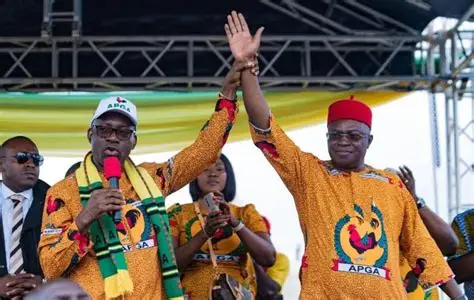
In Kaduna, el-Rufai’s welcome by a mammoth crowd failed to reflect at the polls as Alexander Adanu, the ADC candidate endorsed by the former governor of the state, lost in a wide margin to the APC candidate, Felix Bagudu, who won by 34,580 votes. He defeated Esther Dawaki of the PDP who polled 11,491 votes.

El-Rufai’s loss further extended to the two State Assembly by-elections in Zaria Kewaye and Basawa constituencies.
The APC candidate, Dahiru Umar-Sani won Basawa constituency seat with 10,996 votes, defeating the PDP’s Muazu Danyaro who polled 5,499 while the ADC’s Mahmuda Almustapha fell flat with 146 votes. The APC also emerged winner of the Zaria Kewaye constituency by -election.
While the ADC National Secretary, Rauf Aregbesola, could not flex his muscle in Osun State as no by-election was held in the state, the coalition party however had a flagbearer at the Oyo state by-election. Femi Akin-Alamu, contested for the Ibadan North Federal Constituency seat.

The ADC candidate was however far from victory as PDP’s Fola Oyekunle won by 18,404 votes with the APC’s Adewale Olatunji coming behind with 8,312 votes while Akin-Alamu managed to gather 88 votes.

In an overall examination of the polls across the 12 states, the APC won 12 out of the 16 constituencies across the states. APGA won two constituencies while PDP and the NNPP shared the remaining two constituencies.
Judging by the outcome of the by-election, the APC has reasons to state it remains a formidable party ahead of the 2027 election.
Some analysts believe that it is too early to mark the relevance or otherwise of the new opposition platform given the fact that it is barely two months in the consciousness of the electorate in particular and Nigerians in general.

But they are quick to remind the ADC prime movers that they have a Herculean task ahead of them given the strength of the ruling APC and the power of incumbency.
The PDP on the other hand tend to have kept its head aloft the party’s drowning crisis as its doggedness played out at the Oyo state by-election.
The Labour Party had no takers in the by-election as its crisis had sabotaged its chance to test its strength as its candidates were excluded from INEC’s list on account of the divide between the Julius Abure-led faction and the Nenandi Usman committee.