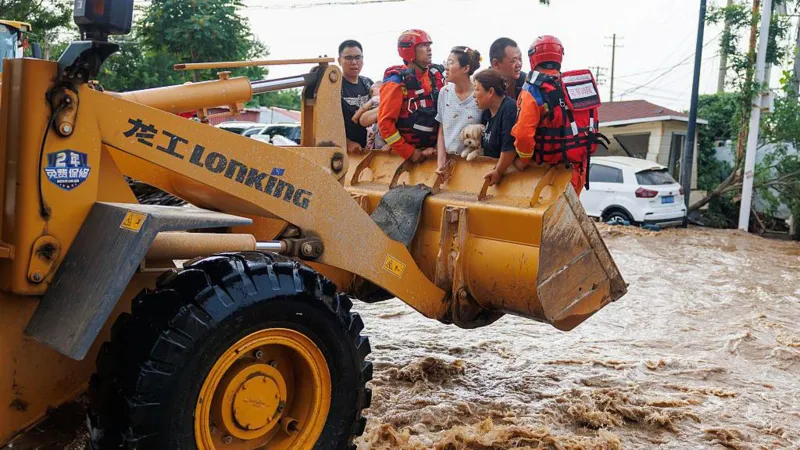
Ms Yang, who works in Hebei province, told BBC Chinese that she was very worried about her family, who live in Miyun district – one of the areas hit hardest by the floods.
Since Sunday she had not been able to contact her parents and grandfather, who all suffer from health problems and have limited mobility. Her family had also been taking care of her pets: eight cats and three dogs.
Their village is small and remote, with just around 10 households, she said, adding that she feared rescuers might miss it altogether. Out of desperation, she took to social media to appeal for rescue, hoping they would be found soon.
Residents from flood-hit areas recalled how quickly the disaster unfolded.
“The flood came rushing in, just like that, so fast and suddenly,” Zhuang Zhelin, a shop-owner in Taishitun town, near Beijing, told the Associated Press. “In no time at all, the place was filling up.”
Zhuang’s neighbour told the Associated Press that when the floods came he “just ran upstairs and waited for rescue”.
“I remember thinking, if no one came to get us, we’d be in real trouble,” he said.
Beijing is no stranger to flooding, particularly at this time of year. One of the deadliest in recent memory occurred in July 2012, when 190mm of rain drenched the city in a day, killing 79 people.
This summer, floods have wreaked havoc across swathes of China.
Two people were killed and 10 people went missing in Shandong province earlier this month when Typhoon Wipha struck eastern China. Two weeks earlier, a landslide killed three people in Ya’an city, southwestern China.
Extreme weather, which experts link to climate change, has increasingly threatened China’s residents and economy – especially its trillion-dollar agriculture sector.
Natural disasters in the first half of the year have cost China 54.11 billion yuan ($7.5bn; £5.7bn), its emergency management ministry said earlier this month. Flooding accounted for more than 90% of the losses, the ministry noted. BBC