

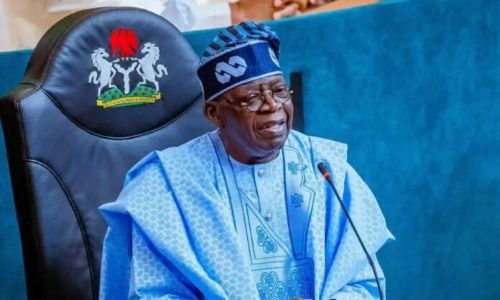
- Agency Report
President Bola Tinubu has called for the reactivation of a regional standby force leveraging Nigeria’s National Counter Terrorism Centre (NCTC) in Abuja.
The proposed force would function as an intelligence and kinetic fusion unit to strengthen regional counter-terrorism responses.
Nigeria’s position was conveyed in an official statement delivered on Saturday by the Minister of State for Foreign Affairs, Amb. Bianca Odumegwu-Ojukwu.
The statement followed a regional conference on security challenges and future risk trajectories in West Africa and the Sahel, held in Accra on January 29 to January 30.
Tinubu reaffirmed Nigeria’s “unwavering commitment to safeguarding peace, security and stability in West Africa and the Sahel”.
He stressed Nigeria’s preference for collaborative and multilateral approaches to address the worsening security crisis across the Sahel region.
According to him, Nigeria continues to disrupt terrorist activities through partnerships with regional intelligence and security structures.
These include the Regional Intelligence Fusion Unit, Liaison Fusion Unit, Eastern African Fusion Unit and the Committee of Intelligence and Security Services of Africa.
The President disclosed that the NCTC signed a Memorandum of Understanding with the African Union in 2025 on continent-wide counter-terrorism cooperation.
“The centre is, therefore, well positioned to support regional mechanisms and serve as an intelligence coordinating hub,” Tinubu said.
He warned that terrorist exploitation of cyberspace for misinformation and disinformation remained a major threat to regional stability.
Tinubu urged neighbouring states to leverage Nigeria’s cyber security infrastructure, citing successes recorded by the National Cyber Security Centre in Abuja.
“Security cooperation remains central to Nigeria’s national interest and regional stability,” he said.
He noted that joint initiatives, intelligence sharing and coordinated operations were essential to tackling terrorism and transnational organised crime.
“We welcome partnerships that respect sovereignty, uphold international law and promote mutual trust,” the President added.
Tinubu acknowledged that insecurity remained volatile, with rising casualties, including women and children, across large parts of West Africa.
He identified weak defence coverage and the absence of a unified counter-terrorism focal point as factors creating exploitable power vacuums.
“These gaps have enabled Sahel-based terrorists to expand towards littoral states, including Nigeria, Benin, Togo and Ghana,” he said.
He warned that such developments allowed terrorists to forge corridors with organised criminal networks across porous regional borders.
Tinubu also expressed concern over possible relocation of South American drug cartels to West Africa amid intensified U.S. anti-narcotics operations.
He said these posed risks of closer links between well-funded drug cartels and insurgent groups in the region.
The President cited overreliance on foreign support, political divisions and the emerging ECOWAS–AES divide as major security challenges.
“To address misapprehensions, political differences must be separated from security cooperation,” Tinubu said.
He urged ECOWAS and AES states to tackle root causes of instability, including poverty, governance deficits and marginalisation.
“As such, tensions must be de-escalated and an inclusive framework restored to reflect shared security and economic interests,” he added. NAN