

- SAfiu Kehinde
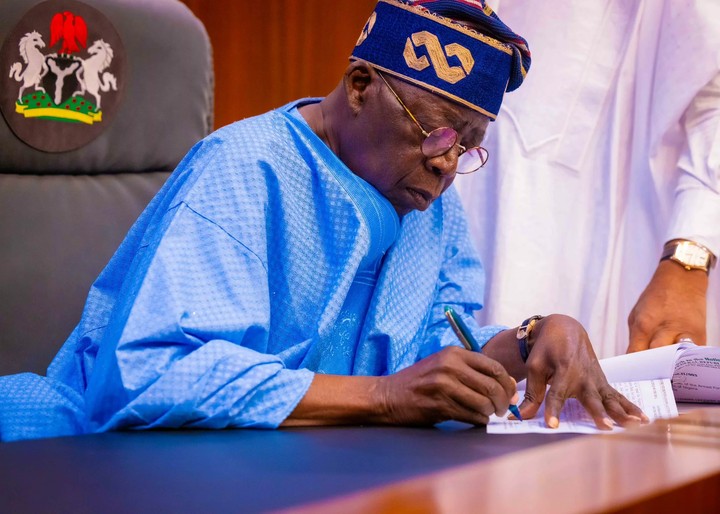
President Bola Tinubu has signed the Electoral Act, 2022 (Repeal and Re-Enactment) Bill 2026 into law.
This is coming hours after the passage of the bill by the National Assembly on Tuesday after months of deliberations.
NPO Reported that both the Senate and House of Representatives had yesterday passed the bill after review and harmonisation of its provisions.
This however occurred in a rowdy session witnessed at both chambers as some lawmakers protested over its passage.
The bill, which had been a subject of controversies over the past weeks on account of the initial rejection of the clause mandating the electronic transmission of election results, would against stir backlash between lawmakers.
At the House of Representatives, Speaker Tajudeen Abass, was faced with a chaotic scene triggered by a motion raised by Francis Waive.
Waive had moved a motion seeking the rescission of the Electoral Act (Amendment) Bill to allow the House to reconsider the legislation.
The Delta state lawmaker’s motion was seconded by Hon. Bayo Balogun, Chairman of the Committee on Electoral Matters.
However, this was turned down by majority of the lawmakers who audibly voted ‘nay’ when thrown to the house by the Abass for voting.
The Speaker’s decision to rule in favour of those who voted in support of the motion would trigger the chaos as lawmakers could be seen challenging one another.
The refusal of the chamber’s leadership to review the provisions of the Electoral Act clause-by-clause further intensified the chaos as lawmakers protested while Deputy Speaker, Benjamin Kalu, read the clauses.
Effort to bring the house back to order proved abortive as the discord continued with some of the lawmakers, identified as members of the Minority Caucus, seen walking out of the chamber.
Video shared on X showed the lawmakers chanting ‘APC Ole! (Thief)’ as they exited the premises.
The Senate also had its fair of the chaos following a demand for division over Clause 60 raised by Senator Enyinnaya Abaribe (ADC/Abia South).
According to reports, Senate President, Godswill Akpabio, had stated that he believed the demand had previously been withdrawn, but several opposition senators immediately objected to that claim.
Citing Order 52(6), the Deputy Senate President, Barau Jibrin, argued that it would be out of order to revisit any provision on which the Senate President had already ruled.
This submission sparked another uproar in the chamber, during which Senator Sunday Karimi had a brief face-off with Abaribe.
The Senate Leader, Opeyemi Bamidele, then reminded lawmakers that he had sponsored the motion for rescission, underscoring that decisions previously taken by the Senate are no longer valid.
He maintained that, consistent with his motion, Senator Abaribe’s demand was in line.
Akpabio further suggested that the call for division was merely an attempt by Senator Abaribe to publicly demonstrate his stance to Nigerians.
The senate president sustained the point of order, after which Abaribe rose in protest and was urged to formally move his motion.
Rising under Order 72(1), Abaribe called for a division on Clause 60(3), specifically concerning the provision that if electronic transmission of results fails, Form EC8A should not serve as the sole basis, calling for the removal of the proviso that allows for manual transmission of results in the event of network failure.
During the division, Akpabio directed senators who supported the caveat to stand.
He then asked those opposed to the caveat to rise.
Fifteen opposition senators stood in opposition.
However, when the votes were counted, the Senate President announced that 15 senators were not in support of the proviso, while 55 senators voted in support of it.