

-
Seeks Stronger Cultural, Academic Ties between Nigeria, Benin Republic
- Safiu Kehinde
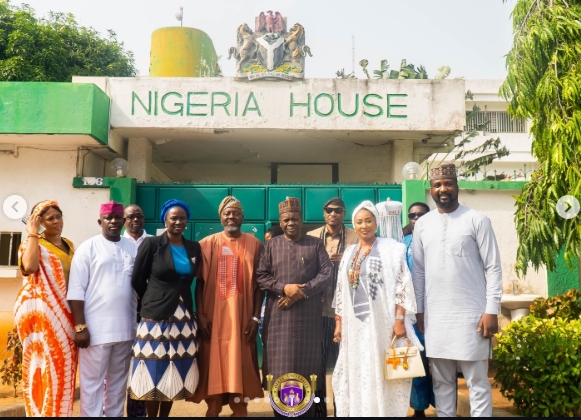
The Vice-Chancellor of Ojaja University, Professor Jeleel Ojuade, has paid a courtesy visit to the Nigeria Ambassador to the Republic of Benin, Ambassador Bukar Kalambe at the Nigeria House, Cotonou.
Ojuade, who was accompanied by the Olu of Ilawo Olori Amb. Dr. Omolara Fashola-MacGregor, visited the Nigeria Embassy in Cotonou on Monday after attending the arts festival held in the Benin Republic capital city last week.
As part of the efforts of bridging the educational gap between Nigeria and Benin Republic, Ojuade, in addressing at the embassy declared that the Ojaja University is open to students from Benin Republic and offers diverse courses tailored to their academic interests.
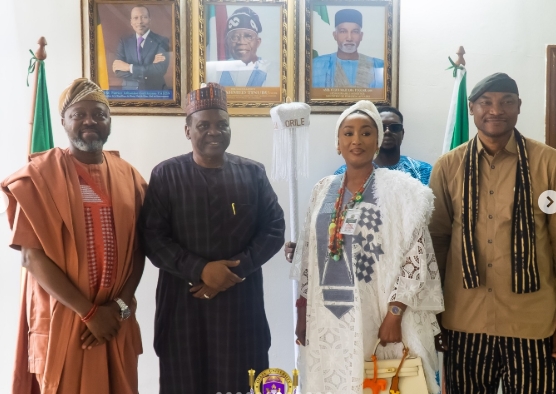
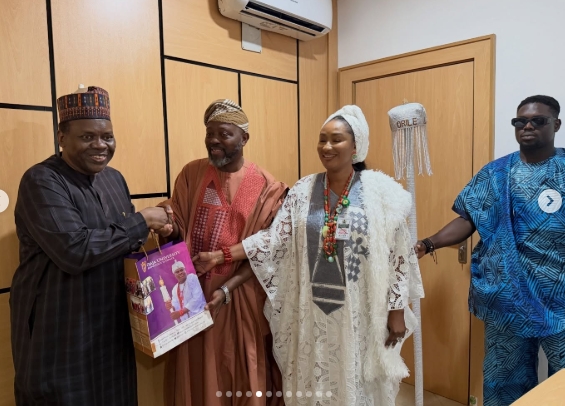
He also expressed the University’s readiness to partner with the Embassy on educational and cultural initiatives.
On his part, Kalamabe assured the Ojaja University delegate that their engagement would not be a one-time visit as he reaffirmed the Embassy’s openness to supporting the academic institution in advancing education and cultural collaboration within its capacity.
Meanwhile, Ojuade had in his keynote address delivered during the arts festival held last week Saturday harped on the cultural ties and history shared by Nigeria and Benin Republic.
“Nigeria and Benin do not merely share geography; we share a cultural bloodstream. Long before contemporary nation-states took their present shape, long before passports and checkpoints became the grammar of movement, creativity already travelled across this region as everyday life.
“Rhythm crossed boundaries without being asked for identification.
“Storytelling moved from compound to compound, town to town, kingdom to kingdom, carrying moral knowledge, humour, grief, aspiration, and the philosophy of how to live.
“Our masquerade traditions did not stop at borders; they belonged to cosmologies larger than modern maps.
“Our languages, tonalities, and metaphors have always echoed one another, sometimes as close siblings, sometimes as cousins, but consistently as members of the same ancestral household.” He said.
Ojuade maintained that both countries share creative inheritance that has survived colonial rule and modern civilisation.
“That is why today is not simply an invitation to celebrate Nigeria in Benin.
“It is a symbolic return to something older than both of us as modern states: a shared creative inheritance that has survived conquest, colonial rearrangement, and the pressures of global modernity.” He said/.
Speaking on the theme of the event, ‘Benin–Nigeria: Creativity, Cultural Power and Regional Unity’, Ojuade noted that Nigeria’s creative industry, though now a continental force, flows through Benin and echoes Beninese ritual and art.
“Nigeria’s creative industries have become a continental force. Afrobeats fills stadiums across Europe and America.
“Nollywood speaks in accents the world now recognises. Our writers, our dancers, our designers, our digital creators, they are shaping global conversation.
“But let us remember something important: no creativity emerges in isolation. The aesthetic river that runs through Nigeria flows also through Benin. The rhythm that drives Lagos pulses in Porto-Novo and Cotonou.
“The same ancestral philosophies that shape Nigerian performance traditions echo in Beninese ritual and art. We are not exporting separate identities. We are projecting interconnected ones.” He said.
The Ojaja University don called for utilisation of both countries’ creative affinity by building mechanisms that allow the shared inheritance to circulate freely across border.
“Nigeria and Benin must begin to treat their creative affinity as structured advantage. Our proximity is not accidental; it is historical. Our shared aesthetics are not coincidental; they are civilisational.
“The way forward requires that we build mechanisms that allow this shared inheritance to circulate freely. Artistic mobility across our borders must become smoother, more predictable, and institutionally supported.
“A region that encourages its artists to collaborate naturally strengthens its diplomatic climate without negotiation.” Ojuade said.
He also called for joint academic research centre with focus on West African performance tradition.
“Secondly, our universities must assume a more courageous role. Academic collaboration must go beyond memoranda of understanding signed for ceremony.
“Joint research centres focused on West African performance traditions, indigenous knowledge systems, digital creativity, and cultural economies must be intentionally developed.” He added.