

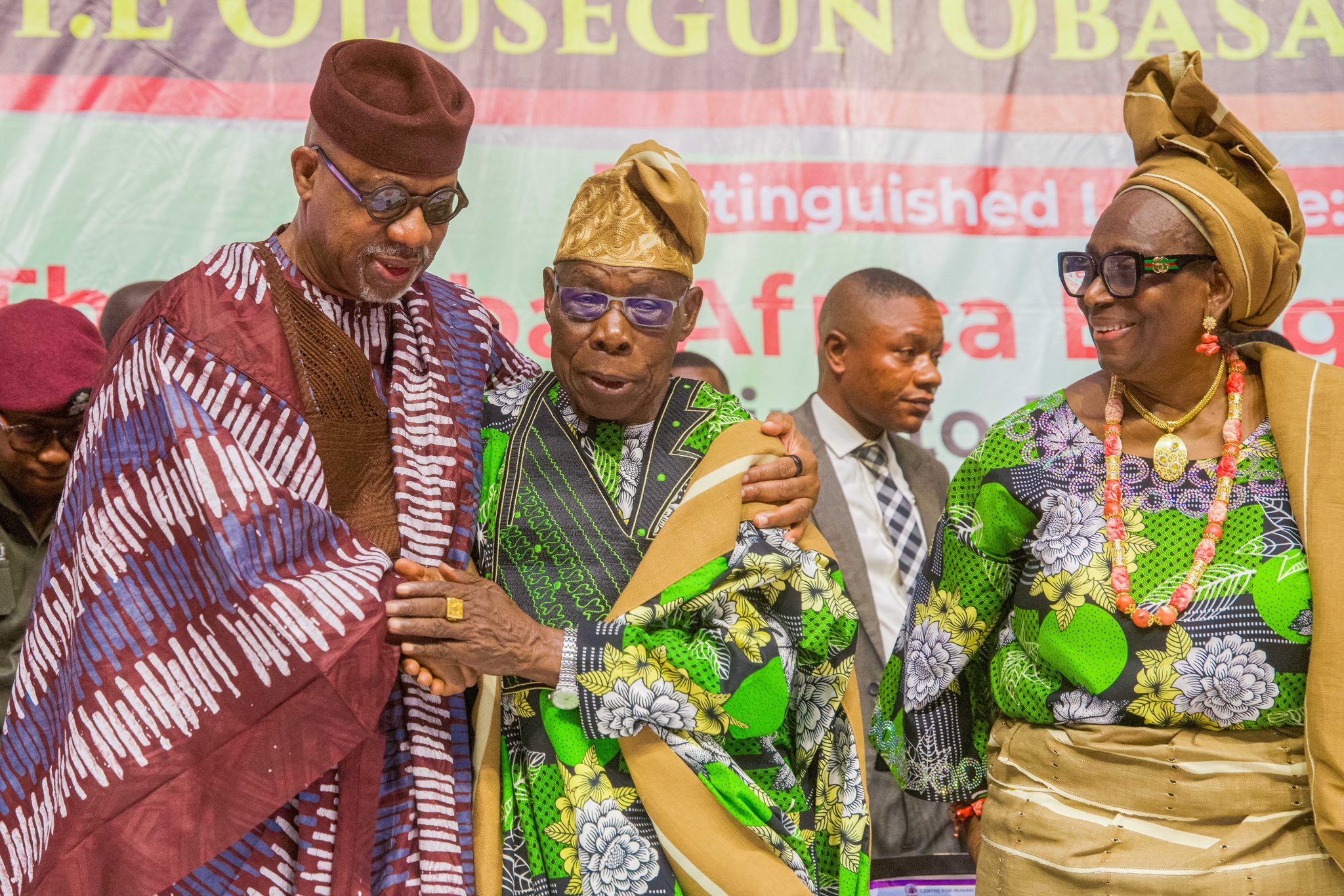
- Safiu Kehinde
Ogun State Governor, Prince Dapo Abiodun, has harped on the need for young Africans to study the leadership and principles of former Nigerian President, Olusegun Obasanjo, as he celebrates his 89th birthday.
Abiodun stated this during the 89th birthday lecture held in honour of the elder statesman.
Speaking on the theme “The Global Africa Enlightenment: From Chains to Renaissance,” at the lecture held on Thursday at the Olusegun Obasanjo Presidential Library in Abeokuta, the governor noted that Obasanjo’s achievements during his tenure should not just be celebrated.
He held that the principles that guided his decision which birthed the achievements needs to be studied.
“Young Africans must study figures like Baba, not merely to celebrate their achievements but to understand the principles that guide their decisions.
“They must learn how leadership, when driven by purpose and service, can influence the direction of a nation and even a continent,” Abiodun said.
The governor maintained that national development depends on strong institutions and leaders who are willing to think beyond immediate interests.
He noted that the theme of the lecture reflects Africa’s historical journey—from the experience of colonial domination to the ongoing pursuit of dignity, development, and progress.
Abiodun stressed that the future of Africa lies in strengthening institutions, investing in knowledge, and building societies that uphold justice, innovation, and unity.
He recalled that the establishment of the National Economic Empowerment and Development Strategy (NEEDS) during Obasanjo’s administration laid a strong foundation for economic restructuring, fiscal discipline, and reforms in the public sector.
The governor further noted that during Obasanjo’s presidency from 1999 to 2007, several significant reforms were introduced to reposition the Nigerian economy.
These included the creation of the Economic and Financial Crimes Commission, the banking sector reforms of 2003, and transformative reforms in the telecommunications industry.
“Beyond Nigeria, Baba, your influence has extended across Africa and the wider international community, particularly in the area of conflict resolution and diplomacy.
“Over the years, you served as a mediator and peace envoy in several regional conflicts, including efforts in Liberia, Ethiopia, and the Democratic Republic of the Congo.
“Through the African Union, the United Nations, and various global initiatives, you have consistently promoted dialogue as a pathway to peace and stability.” He said.
Abiodun further noted that as military Head of State, Obasanjo played a significant role in supporting liberation movements across the continent.
He recalled that Nigeria stood firmly against apartheid and colonial rule because Obasanjo believed that the freedom of one African nation is closely tied to the freedom of all.
On his part, the Haitan Ambassador Extraordinary and Plenipotentiary to the Republic of South Africa, Jean Robert Pillard, held that Obasanjo’s call for a Global Africa Enlightenment is not merely poetic expression but a policy direction and blueprint for the renewal of African civilisation.
Pillard, in his lecture titled “The Global Africa Enlightenment: From Chains to Renaissance,” said history binds people together while culture reminds humanity of its shared identity.
Pillard noted that culture should not be seen as nostalgia but as proof that separation among African peoples was political rather than spiritual.
He explained that the concept of the Global Africa Enlightenment is not an invention but a reunion of peoples with shared history and heritage, adding that while history preserves memory, destiny requires action.
Also speaking at the event, the Alake of Egbaland, Oba Adedotun Aremu Gbadebo, described the celebrant as a role model for many Nigerians and Africans.
He added that generations yet unborn would continue to benefit from Obasanjo’s immense contributions to the development of Nigeria and the African continent.