

- Safiu Kehinde
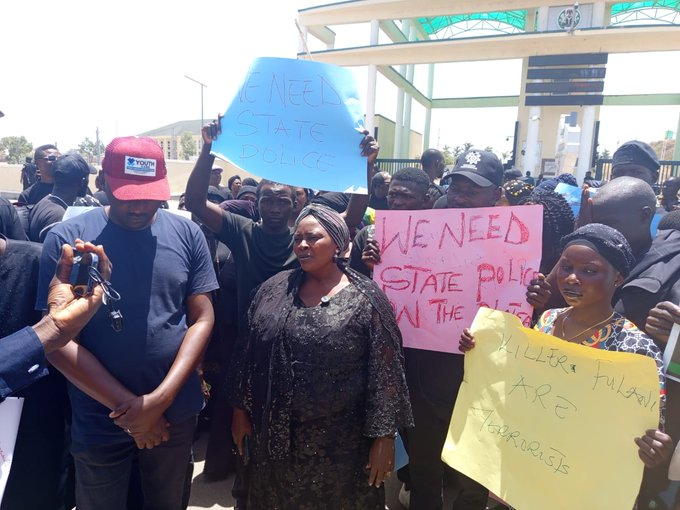
Scores of youths have stormed the Plateau State Government House on Wednesday in protest over the incessant killings and kidnappings across the state.
The youths, under the aegis of Coalition of Northern Zone Ethnic Nationalities and the Plateau Youth Coalition, initially took to the street of Jos, the state’s capital, before marching down to the government house.
According to reports, the youths who stormed the government house with placards and banners expressed their frustration over persistent attacks in rural areas and a deteriorating security landscape that has disrupted lives, livelihoods, and local economies.
The protest comes against a backdrop of repeated violent incidents that have plagued Plateau communities for months.
Attacks and abduction of residents have over the years left many Plateau communities in desolate with local security forces have struggled to contain the activities of armed groups.
The protest also came under the heels of the recent abduction of the Chairman, Evangelical Church Winning All (ECWA) Board of Trustees, Rev. Sunday Agang.
Addressing the media, the protest organizers said they had come together to amplify the voices of ordinary citizens who feel their safety has become gravely threatened.
“If security agents who are supposed to protect us can be ambushed, then what about civilians? Our lives are increasingly at risk,”one of the protest leaders said.
The protest was led by youth representatives including Ezekiel Peter Bini, President of the Plateau Youth Coalition, and Barrister Dalyop Solomon Mwantiri, President of the Berom Youth Movement and Chairman of the Coalition of Northern Zone Ethnic Nationalities.
In a public address during the demonstration, the leaders reiterated that residents are no longer willing to wait for assurances from government officials when attacks continue unabated.
They pointed to incidents in local government areas such as Kanam, Rim, Barkin Ladi, and Riyom, where security forces were ambushed on patrol and villagers killed or forced to flee.
The Plateau youths urged both the state and federal governments to rethink approaches to containing violence, prioritizing proactive planning, better intelligence, and improved coordination between local communities and security agencies.
In a list of demands presented to state officials at the Government House, the youth coalitions called for immediate deployment of security personnel to areas with recent attacks, establishment of permanent security checkpoints in vulnerable rural communities, and strengthening of intelligence-gathering mechanisms to pre-empt attacks.
They also demanded regular security briefings by government representatives to keep citizens informed, collaboration with local youth and community leaders to improve early warning systems, and support for displaced residents including food, shelter, and psychosocial care.
The youth leaders stressed their call was not an attack on security forces but a plea for greater protection of civilians. “Our security agencies are doing their best with limited resources, but there must be an overhaul of the current approach so the threats do not outpace the response,” one leader said.
State officials received the protesters and assured them that their concerns would be conveyed to federal authorities.
However, no immediate policy announcement was made during the protest, leading many participants to vow to escalate their advocacy if tangible results are not forthcoming.