

-
Increases Number of Committee Members to 12
- Safiu Kehinde
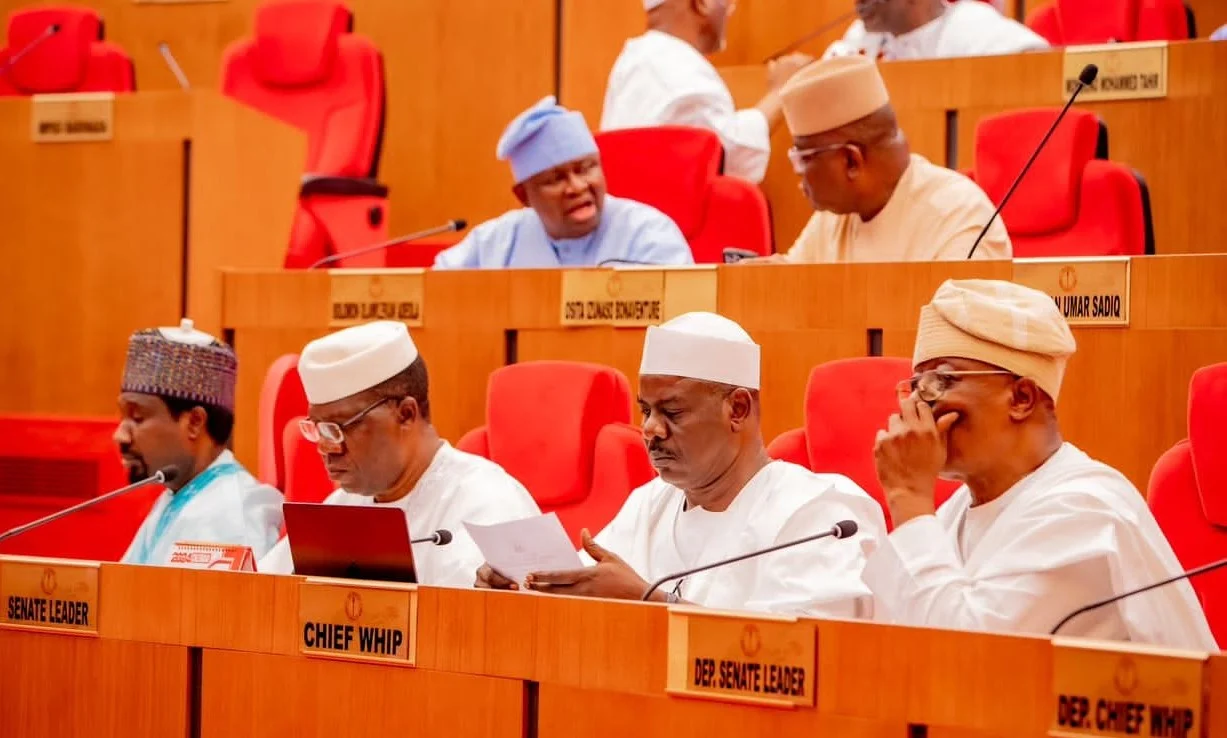
The Senate has reversed its decision on the Electoral Act amendment bill as it approved the clause seeking electronic transmission of results from polling units to the Independent National Electoral Commission’s (INEC) Result Viewing Portal (IREV).
NPO Reported that the Senate had converged for an emergency plenary session on Tuesday amid backlash and protest over the removal of the clause during the passage of the bill last week.
Bowing to pressure from the public, the lawmakers voted for the passage of the clause alongside the bill.
The Senate however approved the electronic transmission without the ‘real time’ phrase while also retaining the use of manual collation.
According to report, the newly amended bill stipulated that where internet connectivity fails, the Form EC8A will remain the primary instrument for result collation.
Under the proposal, electronic transmission would serve as the primary method of uploading results.
The initial mention of the Form EC8A sparked disputes among lawmakers with some condemning the retaining of Form EC8A in the motion raised by Sen. Tahi Mungono.
Moving the motion, Monguno recalled the passage of the Electoral Act Repeal and Enactment Bill by the senate last Wednesday.
“Note that upon careful examination of the bill, fresh issues have emerged in respect of clause 60(3), requiring further legislative consideration for smooth, transparent elections.
“Relying on the provisions of Orders 1(b) and 52(6) of the Senate Standing Orders, 2023, as amended, I hereby move accordingly.
“That I resolve to rescind my earlier motion on Clause 60(3) of the Electoral Act Bill, as previously passed by the senate to replace ‘transfer’ with ‘transmit’.
“I also move that clause 60(3) be recommitted to the committee of the whole for further reconsideration and passage.
“The reason behind this amendment is that I was the one who moved the motion for the retention of the existing act.
“The controversy that it has generated has led me to rescind the decision,” Monguno stated.
This prompted Senator Enyinnaya Abaribe to call for an individual vote on the matter to clearly determine the position of each lawmaker.
Abaribe’s call for individual vote further stirred tension in the house, forcing him to withdraw the motion which was however passed by the lawmakers with the vote conducted.
During the reconsideration of the motion, the senate adopted all the clauses of the Electoral Act amendment bill after extensive deliberations by lawmakers.
The clause 60(3) was amended to mandate electronic transmission of results from polling units to IReV after EC8A forms might have been signed and stamped.
The amendment specified the signing by the presiding officer and available party agents at polling units before the electronic transmission.
It also provided that where electronic transmission failed due to communication issues, the EC8A form signed or countersigned shall remain primary.
The amendment further stated that in such cases, the signed EC8A shall serve as the basis for collation and declaration of election results.
The amended clause 60(3) reads: “that results shall be transmitted electronically from each polling unit to IReV.
“And such transmission shall be done after the prescribed EC8A has been signed and stamped by the presiding officer and party agents who are available at the polling unit.
“Provided that if the electronic transmission of the result fails as a result of communication failure, the result contained in form EC8A signed by the presiding officer and/or countersigned by the polling agents shall, in such a case, be the primary source of coalition and declaration of results.”
Meanwhile, the upper chamber increased the number of its conference committee members from nine to 12 for the harmonisation of differences between its version of the Electoral Act (Amendment) Bill and that of the House of Representatives.
As read by Senate President, Godswill Akpabio, the members of the committee chaired by Sen. Simon Lalong include Sen. Mohammed Tahir Monguno, Adamu Aliero, Orji Uzor Kalu, Abba Moro, and Asuquo Ekpenyong.
Others include Aminu Iya Abbas, Tokunbo Abiru, Niyi Adegbonmire (SAN), Jibrin Isah, Ipalibo Banigo, and Onyekachi Nwebonyi