

- Safiu Kehinde
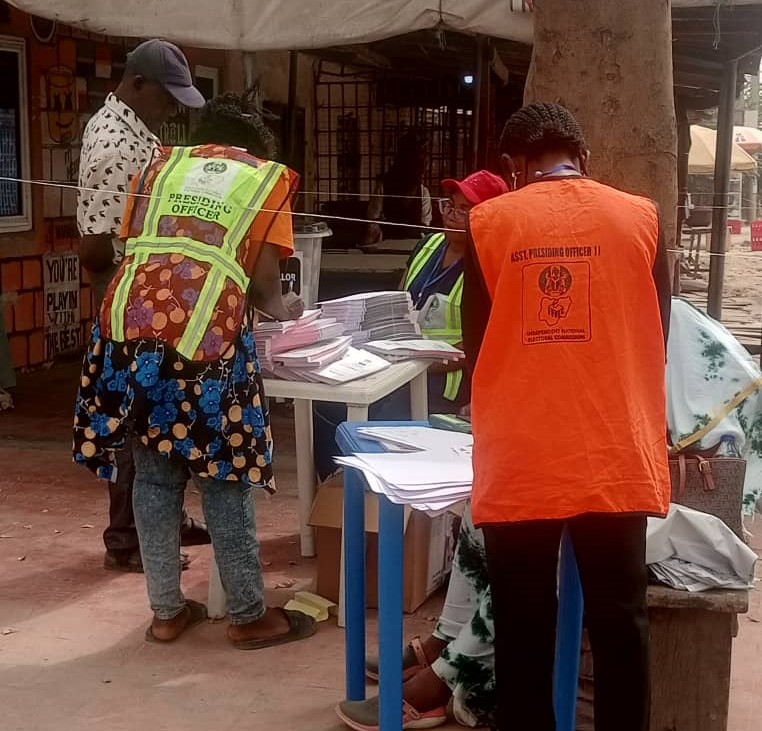
The Independent National Electoral Commission (INEC) has made clarifications on the reported split of polling units and transfer of voters during the 2026 Federal Capital Territory (FCT) Council Election held on Saturday.
NPO Reported that the election held across all the six Area Councils in the capital city saw the All Progressive Congress (APC) emerging winner in five council areas while the Peoples Democratic Party (PDP) won at the last council.
The conduct of the election had however been heavily criticised with several issues such as vote buying, violence, and delay in arrival of election officials, raised.
Also mentioned was voters’ apathy which some opposition figures attributed to the relocation of some voters to other polling units.
Reacting to the claim in a statement issued on Tuesday by Adedayo Oketola, the Media Adviser to INEC Chairman, Prof. Joash Amupitan, admitted to the difficulties experienced by some voters in locating their polling units.
As against claims, INEC maintained that there was no migration of voters in the 2026 FCT election.
The commission held that it had only decongested some overpopulated polling units by splitting the units- an arrangement which Oketola claimed to have been done back in 2022 with the creation of over 56,000 additional polling units.
“Contrary to claims in some quarters that voters were migrated to new or different polling units shortly before the election, the Commission states categorically that no voter was migrated in 2026.
“Under its Expansion of Voters’ Access to Polling Units initiative, the Commission in 2022 created over 56,000 additional polling units nationwide, increasing the total number of polling units from 119,972 to over 176,000.
“In order to populate the newly created polling units, many of which had zero registered voters at the time, 6.7 million voters were migrated from about 12,000 congested polling units to approximately 17,000 less congested polling units across the country.” The statement partly read.
In the FCT election, INEC said 411 polling units were decongested, with about 580,000 voters redistributed to 1,156 polling units.
The Commission noted that no new voter migration was carried out in 2026 as it reiterated that the split polling units referenced in recent discussions were created in February 2022 with addition of the Bimodal Voters Accrediation System (BVAS).
“For clarity, split polling units are additional voting points and BVAS devices deployed to ease voter accreditation and fast-track voting in large polling units with more than 1,250 registered voters.
“The objective is to enhance orderliness, reduce overcrowding and improve the overall voting experience. These split units are located only a few metres away from the original polling units and remain within the same premises.” The statement continued.
INEC further clarified that the splitting of polling units did not alter voters’ registration status, but merely redistributed voters within the same location for administrative efficiency.
However, the Commission observed during the mock election in the FCT that many voters who were migrated in 2022 were still experiencing difficulties locating their polling units, necessitating targeted intervention.
Accordingly, text messages and emails were sent to affected voters on Wednesday 18th, Thursday 19th, Friday 20th and Saturday 21st February 2026, indicating the locations of their polling units.
“These notifications were intended solely as reminders to assist voters in identifying their designated voting points.
“The Commission encourages voters to verify their polling details ahead of elections and, where possible, physically visit their polling locations prior to Election Day.” The commission said.
INEC reiterated its commitment to continuous improvement in electoral service delivery and urges voters to take advantage of all verification platforms provided in order to avoid unnecessary inconvenience.