

- Safiu Kehinde
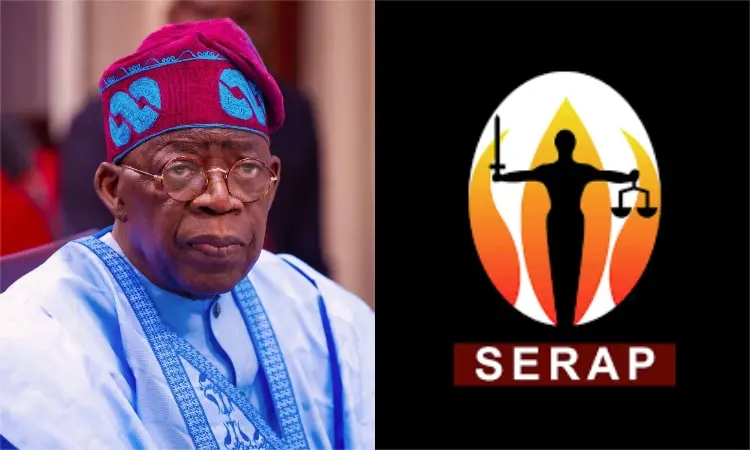
The Socio-Economic Rights and Accountability Project (SERAP) has charged President Bola Tinubu to order probe of the Ministry of Power and the Nigerian Bulk Electricity Trading Plc. (NBET) over the missing N128 billion in public funds.
This was contained in a statement issued on SERAP’s official website on Sunday.
SERAP, in the statement, that its Deputy Director, Kolawole Oluwadare, had in a letter dated January 3, 2026, urged the president to direct the Attorney General of the Federation and Minister of Justice, Lateef Fagbemi (SAN), alongside relevant anti-corruption agencies, to promptly probe the allegations and ensure accountability.
Kolawole had in the letter disclosed that the allegation was contained in the latest annual report released by the Auditor-General of the Federation on September 9, 2025.
The SERAP Deputy Director called for the prosecution of anyone suspected to be responsible for the missing fund.
“Anyone suspected to be responsible should face prosecution as appropriate, if there is sufficient admissible evidence, and any missing or diverted public funds should be fully recovered and remitted to the treasury,” He wrote.
The organisation also urged President Tinubu to deploy any recovered funds to address the deficit in the 2026 federal budget and to ease what it described as Nigeria’s “crippling debt crisis.”
SERAP said the alleged financial irregularities reflect deep-rooted corruption in the power sector, which continues to undermine electricity supply nationwide.
“Nigerians continue to pay the price for the widespread and grand corruption in the power sector. There is a legitimate public interest in ensuring justice and accountability for these grave allegations,” the letter stated.
According to SERAP, tackling corruption in the sector would help address the persistent collapse of transmission lines and improve Nigerians’ access to regular and uninterrupted electricity.
The organisation warned that the allegations point to “grave violations of the public trust,” as well as breaches of the 1999 Constitution (as amended), Nigeria’s anti-corruption laws, and international obligations.
Citing the Auditor-General’s 2022 audited report, SERAP said the Ministry of Power failed to account for over N4.4 billion transferred to project accounts for the Mambilla, Zungeru and Kashimbilla power projects, noting that there was “no evidence of how the funds were expended.”
The report, according to the organisation, also flagged payments of over N95.4 billion to contractors for various projects without documentation or proof that the projects existed or were executed, raising fears that the funds “may have been diverted.”
Additional concerns include over N33 million spent on foreign travel without approval, more than N230 million allegedly expended on the GIGMIS platform without accountability, and over N282 million paid as non-personal advances to staff in excess of statutory limits.
SERAP also detailed extensive allegations against NBET, including the irregular award of contracts worth over N427 million without evidence of procurement advertisements, and the transfer of more than N7.6 billion into unnamed sub-accounts without authorization.
The Auditor-General further queried payments of over N9.3 billion to Egbin Power Plc without documentation, over N8 billion paid to beneficiaries without proper records, and more than N420 million allegedly paid to ineligible consultants without proof that services were rendered.
Other questioned expenditures include payments for contingency and security charges without approvals, consultancy services outside approved budgets, re-awarded contracts without competitive bidding, and vehicle purchases without due process.
SERAP said NBET also engaged in extra-budgetary spending exceeding N1.1 billion without approval from the Minister of Finance or the National Assembly, as well as undocumented payments to supermarkets for staff welfare packages and unapproved legal and training fees.
“We would be grateful if the recommended measures are taken within seven days of the receipt and/or publication of this letter,” SERAP said, warning that it would consider legal action if the government fails to act.
The organisation cited multiple constitutional provisions obligating the government to abolish corruption, promote social justice, and ensure that Nigeria’s resources are managed for the common good.
It also referenced Nigeria’s obligations under the United Nations Convention against Corruption, which requires effective and dissuasive sanctions for cases of grand corruption.