

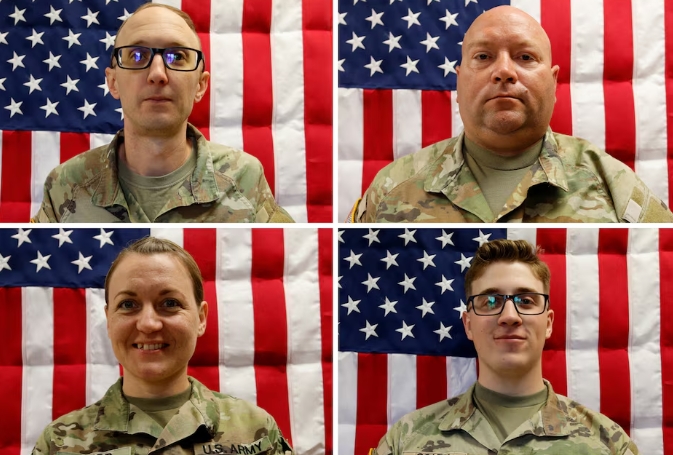
- Safiu Kehinde
The United States Army has on Tuesday identified four of the first American soldiers killed in the war against Iran.
This is coming days after President Donald Trump’s confirmation of the six casualties recorded during Sunday’s drone attack on the US military facility in Port Shuaiba, Kuwait.
However, only four out of the six casualties have been identified with their names and pictures released on the US Army Reserves X handle on Wednesday.
According to Reuters, the four soldiers were members of an Iowa unit of the U.S. Army Reserve.
The Pentagon would further disclose that the four ranged in age from 20 to 42 and served in the 103rd Sustainment Command from Des Moines, Iowa, part of the Army’s global logistics and supply operation.
The military identified the four U.S. Army Reserve soldiers as Captain Cody A. Khork, 35, of Winter Haven, Florida; Sergeant 1st Class Noah L. Tietjens, 42, of Bellevue, Nebraska; Sergeant 1st Class Nicole M. Amor, 39, of White Bear Lake, Minnesota; and Sergeant Declan J. Coady, 20, of West Des Moines, Iowa.
In the same vein, the Chief of US Army Reserves, Lt. Gen. Robert Harter, hailed the late soldiers for their selfless defence of the country.
“We honor our fallen Heroes, who served fearlessly and selflessly in defense of our nation.” Harter wrote.
Most of the soldiers, according to Reuters, had a history of overseas service.
Khork had deployed to Saudi Arabia in 2018, Guantanamo Bay, Cuba in 2021 and Poland in 2024. Amor deployed to Kuwait and Iraq in 2019. Tietjens had two other deployments to Kuwait in 2009 and 2019.
Coady, who was posthumously promoted from specialist, had only enlisted in the Army Reserve in 2023.
Meanwhile, Trump and other senior officials have warned the Iran conflict will result in more U.S. military deaths as Tehran retaliates against U.S. and Israeli strikes.
The U.S. military’s Central Command said on Tuesday that Iran has launched over 500 ballistic missiles and over 2,000 drones in its retaliatory attacks throughout the Middle East so far.
The risks to U.S. forces in the Middle East came up during a closed-door briefing to lawmakers on Tuesday by Defense Secretary Pete Hegseth, General Dan Caine, chairman of the Joint Chiefs of Staff, CIA Director John Ratcliffe and Secretary of State Marco Rubio.
“They told us in that room that there are going to be more Americans that are gonna die – that they are not … going to be able to stop these drones,” Senator Chris Murphy, a Democrat, said.
The facility in Kuwait where the four deaths occurred was protected by concrete blast walls but did not have a fortified roof, two officials told Reuters.
It was unclear if there were air defenses in place but no alarm apparently sounded as the drone approached, one of the officials added, speaking on condition of anonymity.