

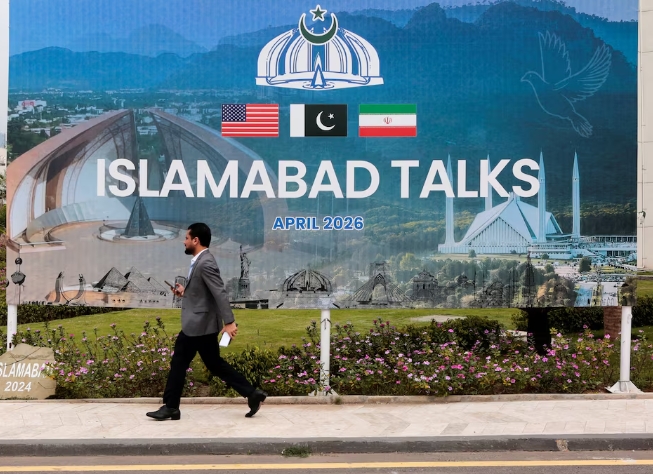
The United States and Iran failed to reach an agreement to end their war despite marathon talks that concluded on Sunday in the Pakistani capital Islamabad, jeopardising a fragile ceasefire.
Each side blamed the other for the failure of the 21-hour negotiations to end fighting that has killed thousands and sent global oil prices soaring since it began over six weeks ago.
“The bad news is that we have not reached an agreement, and I think that’s bad news for Iran much more than it’s bad news for the United States of America,” Vice President JD Vance, the head of the U.S. delegation, told reporters shortly before he left Islamabad.
U.S. CITES ‘RED LINES’, IRAN SAYS DEMANDS ‘EXCESSIVE’
“So we go back to the United States having not come to an agreement. We’ve made very clear what our red lines are.”
The U.S. and Iranian delegations have left Islamabad to return home, Pakistani sources told Reuters.
Vance said Iran had chosen not to accept American terms, including not to build nuclear weapons.
“We need to see an affirmative commitment that they will not seek a nuclear weapon and they will not seek the tools that would enable them to quickly achieve a nuclear weapon. That is the core goal of the president of the United States, and that’s what we’ve tried to achieve through these negotiations.”
The talks in Islamabad, after a ceasefire earlier in the week, were the first direct U.S.-Iranian meeting in more than a decade and the highest-level discussions since the 1979 Islamic Revolution.
Iran’s semi-official Tasnim news agency said that “excessive” U.S. demands had hindered reaching an agreement. Other Iranian media said there was agreement on a number of issues but that the Strait of Hormuz and Iran’s nuclear programme were the main points of difference.
A spokesperson for Iran’s foreign ministry said the talks were conducted in an atmosphere of mistrust. “It is natural that we shouldn’t have expected to reach agreement in just one session,” the spokesperson was quoted as saying by Iranian media.
Pakistan’s Foreign Minister Ishaq Dar said it was “imperative” to maintain the two-week ceasefire that was agreed on Tuesday as the two sides attempted to wind down a war that began on February 28 with air strikes by the U.S. and Israel on Iran.
Israeli security cabinet minister Zeev Elkin told Army Radio that more talks were still an option, but warned: “The Iranians are playing with fire.”
In his brief press conference, Vance did not mention reopening the Strait of Hormuz, a choke point for about 20% of global energy supplies that Tehran has blocked since the war began.