

-
Warns Against Reckless Borrowing
- Safiu Kehinde
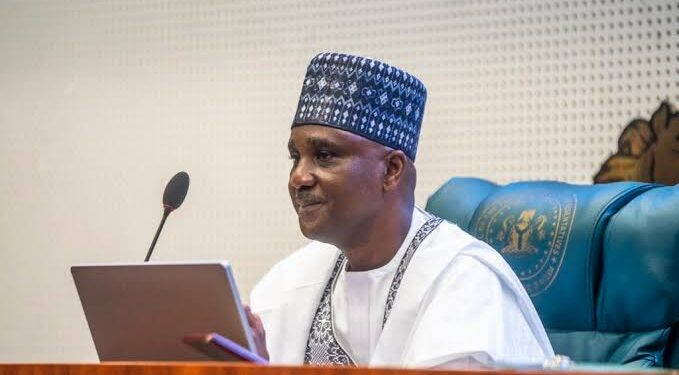
The House of Representatives’ Speaker, Tajudeen Abass, has raised alarm over Nigeria’s debt profile as he warned the government against reckless borrowing.
Abass gave the warning while speaking on Monday at the opening of the 11th Annual Conference and General Assembly of the West Africa Association of Public Accounts Committees (WAAPAC).
The lawmaker, in his address acknowledged public debt as a tool for growth and prosperity when managed prudently.
Abass however disclosed that Nigeria’s debt profile is critically high which may take a drastic toll on the country if not cushioned.
“In Nigeria, recent available data indicate that our debt trajectory has reached a critical point, showing that as at the first quarter of 2025, the total public debt stood at N149.39 trillion, equivalent to about US$97 billion, with domestic borrowing making up 53 percent and external borrowing accounting for 47 percent,
“This represents a sharp rise from N121.7 trillion the previous year, underscoring how quickly the burden has grown.
“Even more concerning is the debt-to-GDP ratio, which now stands at roughly 52 percent, well above the statutory ceiling of 40 percent set by our own laws.
“This breach of our debt limit signals the strain on fiscal sustainability.
“It highlights the urgent need for stronger oversight, transparent borrowing practices, and a collective resolve to ensure that tangible economic and social returns match every naira borrowed.” Abass said
He further said that the debt levels across Africa have “reached alarming proportions”, noting that the continent’s public debt stood at $1.8 trillion in 2022.
“Several countries are now in dangerous debt-to-GDP territory: Sudan at 344 percent, Angola at 136.8 percent, Ghana at 84 percent, Kenya at nearly 70 percent, and South Africa above 77 percent,” The House of Representatives Speaker said.
Abbas noted that in many cases, governments are spending more on servicing debt than on healthcare and other essential services, shrinking the fiscal space available for development, describing it as a “structural crisis” that demands urgent parliamentary attention.