

By Taiwo Adisa, PhD
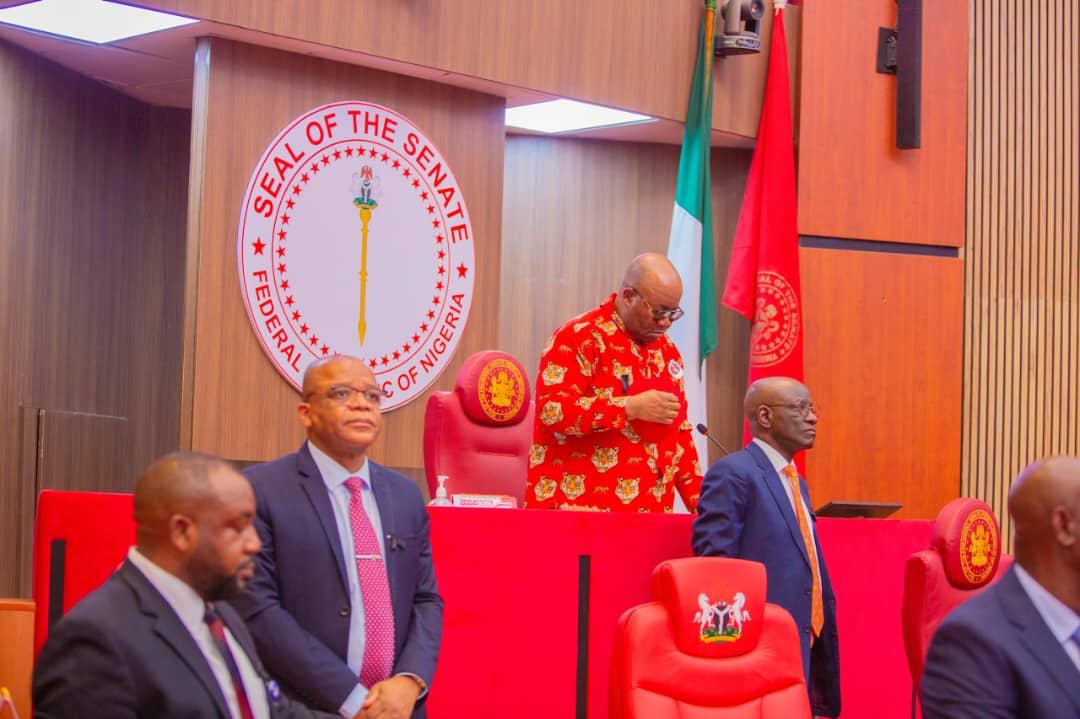
In my article on this page on March 29, 2026, I featured the question of perceived selective justice being meted out to the Senator representing Abia South senatorial district, Senator Enyinnaya Abaribe. It was about an event that happened on the floor of the Senate on March 13, 2026. On that day, some cross-carpeting took place, as we saw senators move from the Peoples Democratic Party (PDP), the Labour Party, and All Progressives Grand Alliance (APGA) to the All Progressives Congress (APC and the African Democratic Congress ADC).
I noted in that article that the President of the Senate, Godswill Akpabio, who read the defection letters of the different lawmakers, caused a stir when it was the turn of the Senator representing Abia South, Enyinnaya Abaribe. Akpabio asked the fifth-term Abia lawmaker to defer his defection plan until he was able to show evidence of division in his party, the All Progressives Grand Alliance. According to Akpabio, his decision was a constitutional reality in line with Section 68 (1g) of the 1999 Constitution. Though Abaribe answered the Senate President that he had evidence of his expulsion from the party by the local chapter several months before, Akpabio said he would give him time to provide the proof.
As I noted at the time, truth is constant, and no matter how fast untruth moves, the truth will catch up with it in a flash. What was at issue in the conversation on the Senate floor on March 13, and my article of March 29, was the question of whether what sauce is for the goose should not be sauce for the gander. Yes, Section 68(1g) of the Constitution was in place when several lawmakers had defected to the ruling APC without question, under the leadership of Akwa-Ibom-born Akpabio, but he chose only to raise a flag when Abaribe decided to defect to the rival ADC. But the Abia Senator has already stated that he had been expelled by members of his party, which provides clear evidence that compels him to anchor in another party, as far as the belligerence by his party members cannot be resolved. It was clear at the time that Akpabio only raised questions about Abaribe’s move because his party was not the beneficiary.
And as our elders would say, while the gods of the days of yore may be slow in action, today’s gods act with the speed of light. Last Thursday, my conviction on Akpabio’s action got further vindicated as Senator Aliyu Wadada announced his defection to the APC. On April 22, when the Nasarawa West Senator announced his defection from the Social Democratic Party (SDP) to the APC, Akpabio had nowhere to hide. Curiously, unlike what happened the day Abaribe announced his defection, Akpabio did not ask whether Wadada had evidence of division in the SDP in line with Section 68(1g) of the 1999 Constitution or not. He also did not threaten to declare Nawarawa Senator’s seat vacant if he could not provide evidence of division in his party. This goes to justify the claim that it is either one works on a straight line, or the truth shall find him out. With his action, Akpabio appeared to have also justified the philosophical claims that there are two reasons for taking an action: the real reason and the true reason. Of course, his reason for attempting to stall Abaribe’s defection may align with the minimalist (deflationary theory of truth), but it appears that the reason for taking that action is not aligned with the truth in reality. Wadada’s defection would swell the number of the APC’s men on the floor, but Abaribe’s decision would swell the ranks of the opposition. So Akpabio acted against the latter. But a presiding officer of his status is supposed to be a statesman. You want to wonder whether a man who is compelled, as a matter of duty, to put the question for the ‘Ayes’ and the ‘Nays’ at every instance, should be afraid of the opposition, which is the true bedrock of democracy.
But aside from the defection story of Wadada, something curious and fundamental to legislative practices again occurred on April 22. This one is capable of inflicting profound damage on the nation’s public finances and legislative oversight. It is like the situation of one man having the yam and the knife at the same time.
After Akpabio had read Wadada’s defection letter, he asked the lawmaker for further clarifications, and the response by the Nasarawa Senator hit our legislative practice below the belt. Remember, Wadada is the Chairman of the Senate Committee on Public Accounts. This is one of the main standing committees of the Senate that is specifically referenced by the Rule Book. The Senate rules cede the leadership of that committee to the opposition party in the chamber. And that was deliberate. The Public Accounts Committee maintains the records on public finance of all Ministries, Departments, and Agencies (MDAs) of government. The decision to cede its leadership to the opposition is deliberate by the planners of our democracy so as to ensure that the legislature is able to always hold the executive and judicial arms of government accountable.
But Wadada’s response to Akpabio that he has resigned from the SDP since 25th August 2025, eight months ago, meant that a member of the ruling APC has been holding the Public Accounts Committee illegally since August 2025. The rules of the Senate do not envisage a situation where the chairman of the Public Accounts Committee would belong to the ruling party. Usually, the position is ceded to the opposition to maintain accountability and credibility in questioning public spending by the MDAs, the Judiciary, and the Federal Government. So, while Wadada’s defection story is curious enough, the fact that he is left to preside over the Public Accounts Committee of the Senate is more of a raised eyebrow against accountability and probity. It is a sign that the legislature is in bed with the executive, and when that happens, brazen impunity would become the order of the day.
Incidentally, the same Wadada had admitted in a television interview that he was originally a member of the APC and that he left the ruling party for the SDP when he was denied the senatorial ticket. He won the election on the ticket of the SDP. It means that even when Akpabio named him the chairman of the Senate Committee on Public Accounts, he was only being clever by half; an insider in APC, dressed in SDP robe, was overseeing the critical public accountability arm of the legislature. Perhaps that was meant to ensure that the nation’s public spending was not scrutinised by the legislature.
But the more confounding matter about Senator Wadada was his announcement by the Nasarawa State governor, Abdullahi Sule, as his preferred successor in 2027. Though the announcement has sparked uproar in the state’s chapter of the APC, leading to questions about whether there are no suitable aspirants in the APC all along, the fact that Wadada was chosen by Governor Sule points further to his long-term romance with the ruling party and his apparent unsuitability for the chairmanship of the Public Accounts Committee.
I will recommend that Akpabio learn some things from the leadership of Senator David Mark, who served two terms as President of the 6th and 7th Senate. Despite the vociferous opposition that Senator Ahmad Lawan used to pose on the floor and his endless probes at the Public Accounts Committee (PAC), Mark left Lawan in charge of the critical Committee throughout his tenure. At that time, the fear of PAC was the beginning of wisdom for all MDAs. The Auditor General’s reports were also promptly delivered to the committee, and the nation had lots of reports on probity and accountability from the Senate. What is happening now leaves much to wonder whether the Senate President or anyone in government is thinking about probity and accountability.
It, however, looks like the Akpabio/Wadada ensemble in the Senate is just one of those ills besetting our legislature, driving down its relevance in the estimation of the people and undermining its very essence in the democratic setting.
Stories abound that under Akpabio’s leadership, the leadership of the Minority Caucus was determined by the presiding officer. This is more than an aberration in the legislature. The fact that democracy rests on two pillars of words and the opposite is incontrovertible in any clime. In simple terms, democracy is you have your say, I have mine. The majority opinion carries the day. A situation where the majority stuffs the neck of the minority with its preferred content is not envisaged in a legislature. In fact, conscientious presiding officers always ask for contrary views to be expressed, especially while debating the general principles of a bill or the contents of a motion. I have heard many presiding officers before Akpabio deliberately stop some contributions if they believed they’ve had enough of positive ideas on an issue, and they would call for those who want to speak against the idea. That is how robust debates are marshaled in a chamber that is worth its name.
It is odd to see a presiding officer loathe opposing views to the extent that he would deliberately engineer the emergence of pliable hands as leaders of the opposition party. That trend started in the House of Representatives around the 8th Assembly, the Senate adopted it in the 10th Assembly, but it is a trend that should not fester.