

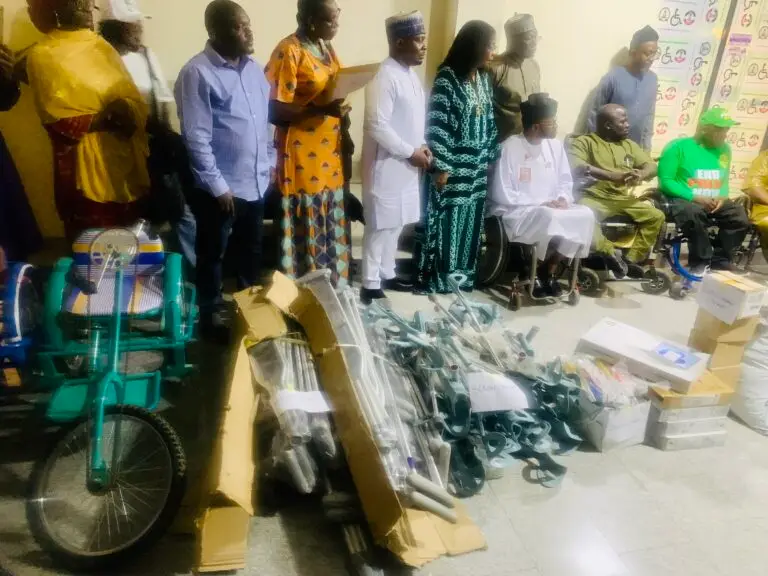
The Economic Community of West African States (ECOWAS), on Friday, distributed assistive devices to children with disabilities in Nigeria as part of efforts to improve access to assistive technology and promote disability inclusion across the region.
The intervention is being implemented under the ECOWAS Regional Programme for the Provision of Assistive Devices to Children with Disabilities in West Africa.
According to reports, the event also marked Nigeria’s participation in the first phase of the programme, alongside Togo, after nearly two years of planning and implementation.
Speaking at the distribution ceremony in Abuja, ECOWAS Commissioner for Human Development and Social Affairs, Prof. Fatou Sarr, said the initiative followed a regional disability inclusion study which revealed severe shortages in access to assistive technology.
According to her, the findings showed that children with disabilities are among the most vulnerable groups in West Africa, prompting ECOWAS to prioritise interventions aimed at improving mobility, communication, learning and social participation.
Sarr said about 240 million children globally live with disabilities, while an estimated 15 per cent of children in West and Central Africa have one form of disability.
Also speaking, the Executive Secretary of the National Commission for Persons with Disabilities, Ayuba Gufwan, said assistive devices restore dignity, independence and opportunity by enabling persons with disabilities to participate fully in education, employment and community life.
“There is ability in disability. No matter the severity of a person’s disability, with the right environment and appropriate assistive devices, everyone can contribute meaningfully to humanity,” he said.
Gufwan said more than 26 million persons with disabilities in Nigeria require assistive technology, with demand for quality, affordable and appropriate devices far exceeding available supply.
He added that about nine out of every 10 persons with disabilities require one form of assistive technology or another, yet the overwhelming majority still lack access.
According to him, the situation continues to exclude millions from education, healthcare, employment and independent living.
“Behind these statistics are children who cannot attend school because they lack mobility devices, adults excluded from employment because they do not have access to appropriate technology, and families struggling to access rehabilitation services,” he said.
He commended ECOWAS for selecting Nigeria as one of the first beneficiaries of the regional programme.
Gufwan also called on governments, development partners, healthcare professionals, civil society organisations and the private sector to strengthen collaboration to ensure sustainable access to assistive technology.
He advocated the establishment of local manufacturing and assembly plants for assistive devices, saying domestic production would reduce dependence on imports, lower costs, improve availability, stimulate innovation and create jobs.
The Minister of Humanitarian Affairs and Poverty Reduction, Dr Bernard Doro, reaffirmed the Federal Government’s commitment to protecting the rights and welfare of persons with disabilities.
Represented by his Senior Technical Adviser, Dung Dalyop, the minister said the initiative aligned with the ministry’s integrated approach combining humanitarian response with poverty reduction and social protection.
He noted that persons with disabilities often faced barriers not because of their conditions but because society failed to provide the support and opportunities they needed.
“This ceremony is more than a formal exchange of items. These assistive devices represent dignity restored, independence regained and doors reopened,” he said.
Doro commended ECOWAS for demonstrating regional solidarity through the initiative and urged the commission to ensure transparent and equitable distribution of the devices to those most in need. NAN