

- Odibo Victory
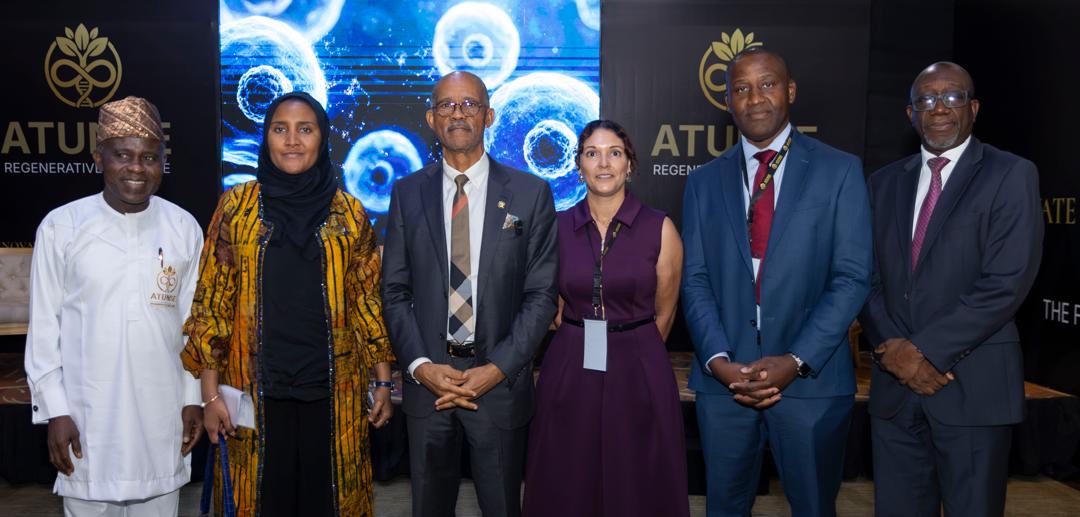
Atunse Healthcare Ltd. has launched in Lagos with plans to manufacture and distribute advanced biologics in Nigeria and develop the specialist workforce required to support their use.
The company, which commenced operations on Friday, said its long-term ambition was to reduce Nigeria’s dependence on imported medicines and overseas healthcare by building local capacity in advanced medicine.
Atunse said it was already treating patients across six service lines, including aesthetic medicine, longevity and vitality, men’s wellness, women’s wellness, musculoskeletal support and neurological care.
Speaking at the launch, Fatima Aliko Dangote, Group Executive Director of Commercial Operations for Oil & Gas, Dangote Industries, who represented the keynote speaker, Alhaji Aliko Dangote, said the COVID-19 pandemic had exposed the risks of relying heavily on external sources for essential health technologies.
“COVID-19 taught us a very important lesson: dependence is a vulnerability,” she said. “For us in Africa, medical sovereignty cannot just be a slogan. It is about building the capacity to protect our people.”
She said initiatives such as Atunse could help move Africa from being predominantly a consumer of advanced medicine to becoming a producer.
Dangote also stressed the need for partnerships between government, the private sector, scientists and investors to strengthen healthcare capacity on the continent.
Atunse Healthcare is a partnership between KweHealth LLC of the United States and Tri-State Healthcare System of Nigeria.
According to the company, KweHealth contributes its scientific and manufacturing platform, while Tri-State Healthcare System provides clinical delivery and institutional capacity.
The company said it was developing four capabilities, including clinical delivery, advanced biomanufacturing, research and clinical translation, and regulatory capacity.
It said its biomanufacturing plans included working towards cGMP-grade production of advanced biologics in Nigeria, with a roadmap that could extend to vaccines and eventually cell and gene therapies.
Prof. Akin Abayomi, Lagos State Commissioner for Health, who represented Gov. Babajide Sanwo-Olu at the event, said initiatives such as Atunse could help attract Nigerian doctors and scientists working abroad back to the country.
“When we start seeing initiatives like this, it starts to encourage our own experienced specialists to come back home,” Abayomi said. “This is the kind of initiative that is attractive to doctors and scientists doing great things abroad.”
He said regenerative medicine was an important frontier in healthcare, stressing the need for institutions, skills, data infrastructure and systems to support its development.
“Government cannot do this alone,” he said. “We need the universities, the researchers, the healthcare providers and the private sector working together.”
Abayomi also highlighted the importance of data and digital infrastructure in strengthening Nigeria’s healthcare system.
Meanwhile, Prof. Kamar T. Adeleke, President and Chairman of Atunse Healthcare, said the company’s ambition extended beyond Lagos.
“For a generation, the most advanced medicine of our age has been something Africans travel for. Atunse exists to change the direction of that journey. We begin in Lagos, but what we are building is not for Lagos alone,” he said.
Dr. Sola Oluwole, Chief Executive Officer of Atunse Healthcare, said the company intended to build the capacity to provide treatment, manufacturing and distribution locally.
“What Nigeria loses is not only money. It is the demand, the capital and the clinical talent that need never have left,” Oluwole said.
Dr. Frederick A. Kweh, Chief Science and Technology Officer of Atunse Healthcare, said Africa was increasingly positioning itself as a participant in advanced medicine rather than merely a consumer.
Atunse said it currently works with four investigational platforms developed and manufactured by KweHealth — AVEXO, KH-1814, AIOVA and NKIRA.
The company clarified that the platforms are used only within approved regulatory and ethical frameworks and with informed consent, adding that they are not approved for any indication and that it makes no claims regarding their safety or efficacy.
The company said its workforce development plans would focus on areas including biomanufacturing, quality assurance, regulatory science and clinical research.
It added that the initiative was aligned with the broader push for increased local production of health products in Africa.