


The Federal Airports Authority of Nigeria (FAAN) has cleared Bolt and Uber to resume operations at airports under its management following mounting public outrage over the disruption of e-hailing services and rising transportation costs.
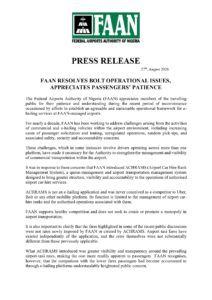
The Authority announced the development in a statement signed by its Director of Public Affairs and Consumer Protection, Henry Agbebire.
FAAN said the decision followed constructive engagements with e-hailing operators to establish an operational framework that addresses regulatory, safety and security concerns while preserving passengers’ access to convenient transportation.
NPO Reports recalls that the development comes after the e-hailing initiative introduced by FAAN attracted heavy backlash over the cost of transportation from the Murtala Muhammed International Airport (MMIA), Lagos.
FAAN had introduced its Airport Car Hire Rank Management System (ACHRAMS), a software-based system designed to manage airport car-hire services, following restrictions on the operations of e-hailing platforms such as Uber and Bolt within the airport environment.
The criticism intensified after a video surfaced showing a traveller enquiring about the cost of using the FAAN-approved car-hire service for a trip from MMIA to the Radisson Blu Hotel in Ikeja.
In the video, an airport official informed the traveller that the trip would cost N30,000, further fuelling concerns over the cost.
FAAN said Bolt had reached an agreeable operational framework with the Authority and had been cleared to commence its services at FAAN-managed airports immediately.
 It added that discussions with other e-hailing operators were ongoing and expressed confidence that the outstanding engagements would be concluded in the coming days.
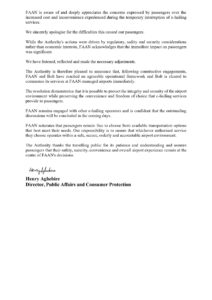
The Authority apologised to passengers for the inconvenience caused by the disruption, acknowledging concerns over increased transportation costs and the difficulties experienced by travellers.
“FAAN is aware of and deeply appreciates the concerns expressed by passengers over the increased cost and inconvenience experienced during the temporary interruption of e-hailing services.
“We sincerely apologise for the difficulties this caused our passengers,” it said.
FAAN maintained that its actions were driven by regulatory, safety and security considerations rather than economic interests, but acknowledged that the immediate impact on passengers had been significant.
“We have listened, reflected and made the necessary adjustments,” the Authority said.
FAAN said it had been working for nearly a decade to address challenges associated with commercial and e-hailing vehicles operating within airport premises.
According to the Authority, these include passenger solicitation and touting, unregulated operations, random pick-ups and concerns over safety, security and accountability.
It added that some drivers operate across multiple platforms, making it necessary to strengthen the management and visibility of commercial transportation within airports.
FAAN said ACHRAMS was introduced in response to these concerns to bring greater structure, visibility and accountability to authorised airport car-hire services.
The Authority stressed that ACHRAMS is not an e-hailing application and was never designed to compete with Uber, Bolt or other mobility platforms.
“ACHRAMS is not an e-hailing application and was never conceived as a competitor to Uber, Bolt or any other mobility platform,” FAAN said.
It added that it supports healthy competition and does not seek to create or promote a monopoly in airport transportation.
The Authority also clarified that the airport taxi fares that generated public criticism were not newly imposed by FAAN or created by ACHRAMS.
According to FAAN, the fares existed independently of the system and were not substantially different from rates previously applicable.
It said ACHRAMS merely provided greater visibility and transparency around prevailing airport taxi rates, making the cost clearer to passengers.
FAAN reiterated that passengers remain free to choose from available transportation options, provided the authorised services operate within a safe, secure, orderly and accountable airport environment.