

- Odibo Victory
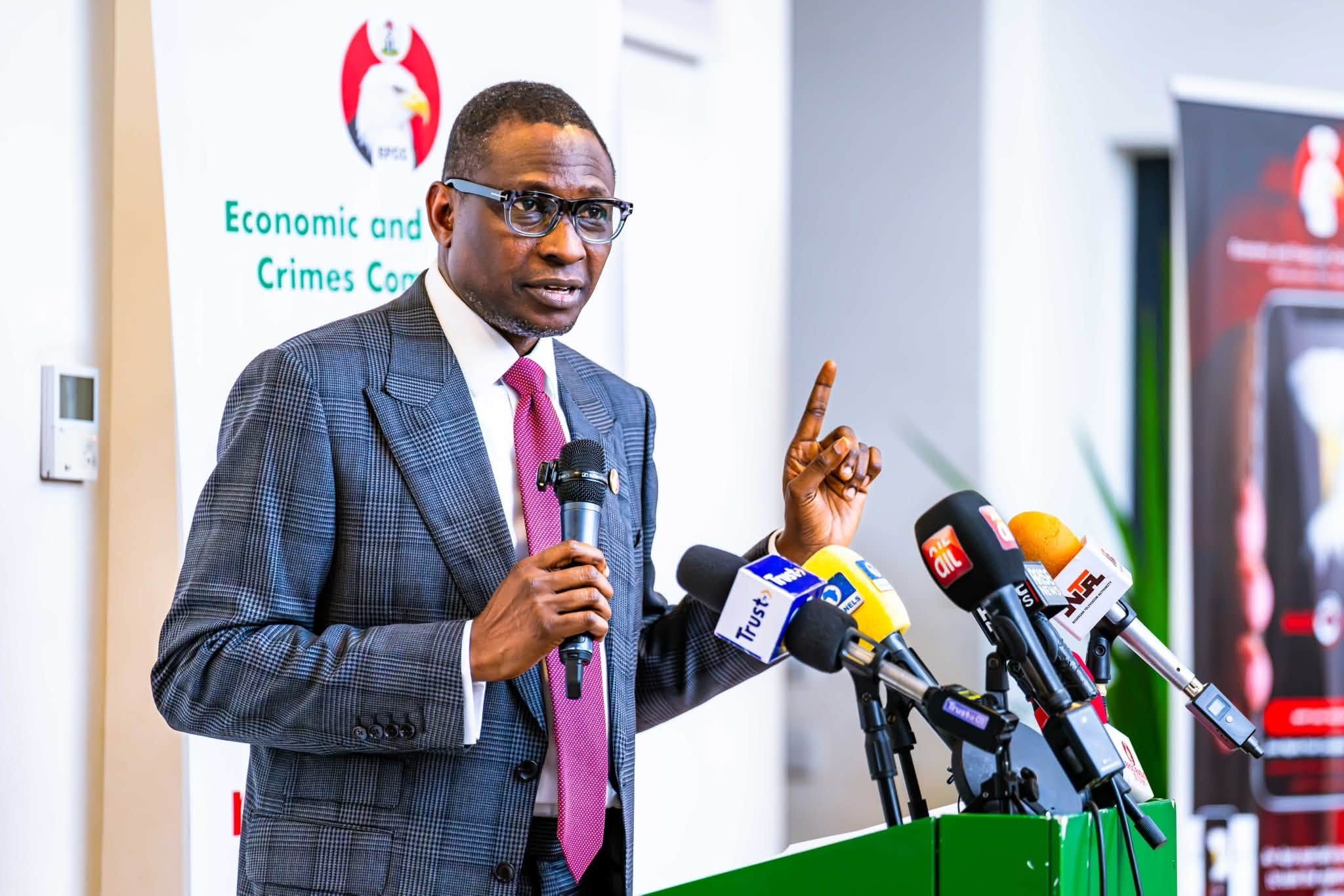
The Chairman of the Economic and Financial Crimes Commission (EFCC), Ola Olukoyede, says the commission is moving away from waiting for financial crimes to happen and is now prioritising early detection, prevention and the freezing of suspicious assets.
Olukoyede made this known on Monday in Abuja during a media interactive session held to mark his third year as EFCC chairman.
He said the commission had established the Fraud Risk Assessment and Control Department (FRAC) to track suspicious financial transactions and intervene within 72 hours.
“Why must we be waiting for money to be stolen? When we see money moving suspiciously, we move in and freeze. Pending 72 hours, where is this money going?” He asked.
He gave an instance where funds were transferred from a local government account to a company and subsequently moved into cryptocurrency wallets, noting that such financial patterns had strengthened the need for proactive intervention.
According to him, some public officials now move stolen funds into cryptocurrency wallets within 24 hours, sometimes using young people to carry out the transactions, thereby making the recovery of the funds more difficult.
“At the press of a button, you can collapse the entire banking industry in Nigeria. Most of the data we are investigating now, you can’t trace tangible assets to them,” the EFCC chairman said.
Olukoyede said the commission was also improving its ability to track cryptocurrency transactions, noting that about 40 virtual asset platforms had been licensed to operate in Nigeria.
He explained that the EFCC now has the capacity to trace registered cryptocurrency wallets.
The EFCC boss further disclosed that, following presidential approval, the commission and relevant government agencies had established a national confiscation wallet for holding seized cryptocurrencies.
“One of the problems we used to have was where do you put confiscated virtual assets. Today we have a national wallet that we put them into,” he said.
On the commission’s legal approach to asset recovery, Olukoyede said the EFCC was using Section 17 of the Advance Fee Fraud Act to pursue civil asset forfeiture rather than waiting for lengthy criminal trials to conclude.
He described the process as faster, saying the commission no longer had to wait 10 or 15 years for criminal trials to end while witnesses could die and assets could be dissipated.
“This is faster and quicker than criminal trial. We don’t have to wait 10, 15 years when witnesses die and assets are dissipated,” he said.
Olukoyede explained that under the civil forfeiture process, the EFCC could institute an action against an asset, while anyone claiming ownership would be required to explain the source of the funds used to acquire it.
He said the strategy had produced results in a number of ongoing cases involving assets linked to former public officials.
Speaking on the management of forfeited properties, the EFCC chairman clarified that the commission does not directly manage recovered assets but engages professionals in accordance with the Proceeds of Crime Act 2022.
“For real estate we have estate managers. For virtual assets we have stock market professionals. For a radio station we call broadcast experts,” he said.
Olukoyede added that the commission had started disposing of assets that were losing value while litigation was ongoing, with the proceeds kept in escrow accounts until the courts reach a final decision.
He disclosed that some high-profile hotels recently forfeited in Lagos were now under new management, while banks had been instructed to remit all income and proceeds from their sales to the EFCC.
To strengthen oversight of recovered assets, Olukoyede said the commission had established a dedicated Process and Proceeds Management (PCM) directorate to supervise all forfeited assets.
The EFCC chairman also called for stronger policies and institutional reforms, stressing that law enforcement agencies alone could not effectively tackle financial crimes and corruption.
“The most effective system is not law enforcement. It is the policy regime, institutional reforms that close leakages,” he said.
He also urged the media and civil society organisations to reclaim their watchdog responsibilities and play a stronger role in the fight against corruption.