

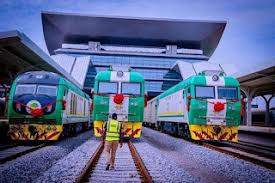
- Agency Report
The Nigerian Railway Corporation (NRC) has urged stronger collaboration between state governments and the Railway Police command to safeguard rail infrastructure nationwide.
Managing Director Kayode Opeifa made the call in a statement issued on Saturday in Lagos.
Opeifa said the railway police command operates across 26 states and urged governments to recognise the unit as part of their security architecture.
He stressed that protecting rail infrastructure was closely linked to securing the country’s mobility corridors.
According to him, the railway is a critical national asset that cuts across many states and supports national development
Drawing from his experience as former Lagos commissioner, Opeifa recalled how the Police assisted the state government during the clean-up of Oshodi.
He said the operation demonstrated the importance of inter-agency cooperation in protecting public assets.
“The history of the Nigerian Railway Corporation is the history of Nigeria itself, and the issues confronting the railway reflect broader national challenges,” he said.
Opeifa said the modern overhaul of Nigeria’s rail system began in 2015 with the introduction of standard gauge lines.
He credited the administration of Muhammadu Buhari with commissioning projects including the Abuja–Kaduna Railway, Warri–Itakpe Railway and Lagos–Ibadan Railway.
He added that the government also initiated the Port Harcourt–Maiduguri Rail Corridor and the Abuja Rail Mass Transit.
Opeifa noted that moving railway from the Exclusive List to the Concurrent List enabled states such as Lagos, Kano, Ogun and Plateau to participate in rail development.
He said his priority was to ensure the corporation drives national integration and economic growth while aligning with international best practices.
“Many developed countries treat railway infrastructure primarily as social infrastructure, and Nigeria’s rail system is playing a similar role.
“Railway is an enabler of growth and federal investments in projects across Lagos, Kano and Kaduna states reflect their strategic economic importance,” he said.
Opeifa disclosed that the corporation had developed a national rail map linking state rail systems with the national network.
Highlighting the eastern corridor, he described the main station in Enugu as a massive facility with underground structures.
He noted that the corridor once contributed significantly to national revenue.
Looking ahead, Opeifa said the corporation planned to electrify major rail corridors within five years, starting with Warri and Lagos.
He said gas availability in the areas could support power generation for electric rail operations.
On ticket racketeering, Opeifa acknowledged the challenge but said new verification procedures had reduced the practice.
Passengers now undergo double checks at waiting areas and during boarding to curb illegal ticket sales.
He also reassured passengers of strong security along the Abuja–Kaduna Railway corridor.
According to him, train movements and station activities are monitored from a central control room.
He said the corporation plans to replicate similar monitoring systems across other rail lines nationwide. NAN