

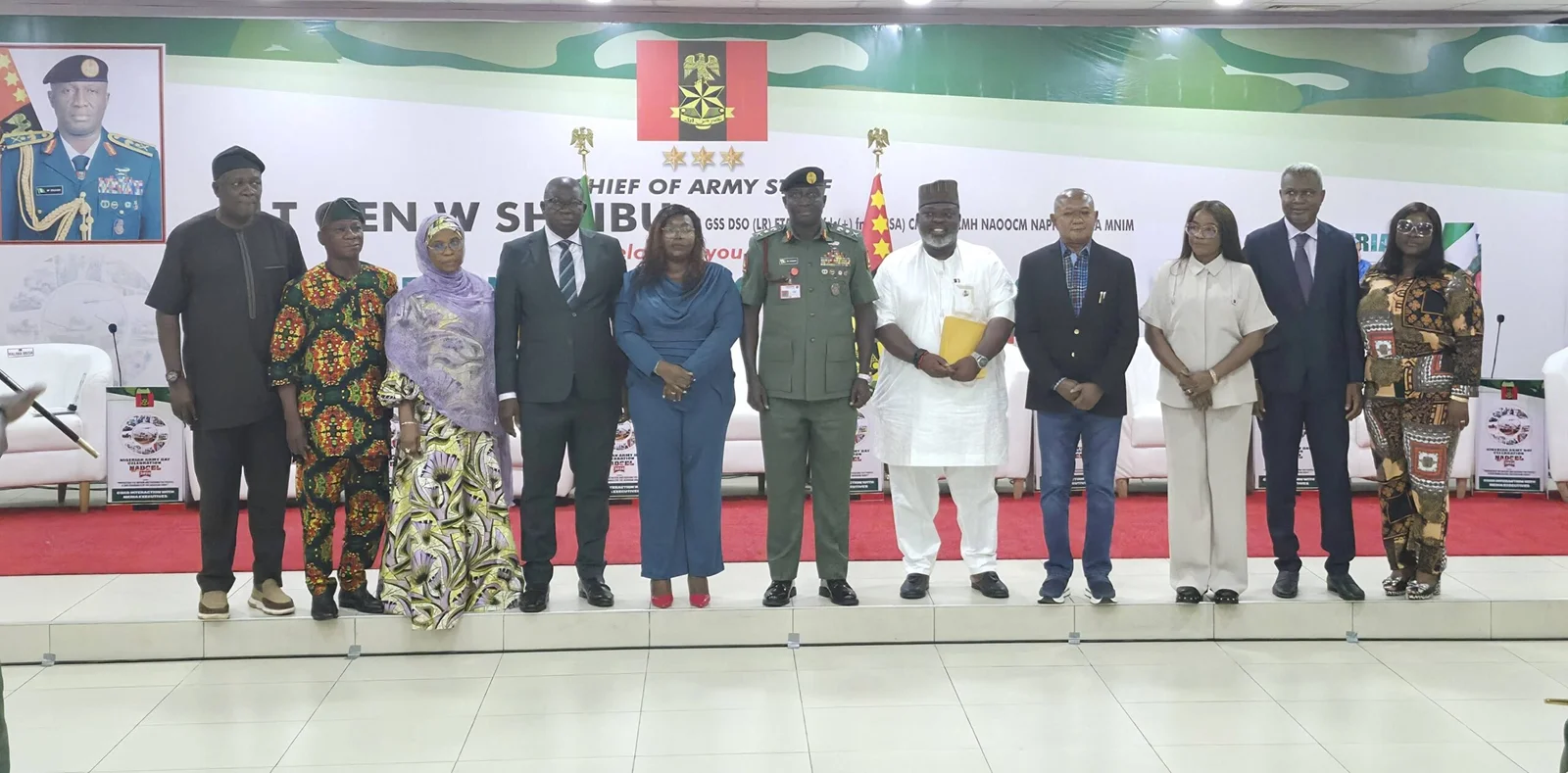
The Chief of Army Staff (COAS), Lt.-Gen. Waidi Shaibu, has said the Nigerian Army is making tremendous progress in ongoing operations to rescue the 39 pupils and seven teachers abducted in Oyo State nearly two months ago.
Shaibu gave the assurance on Saturday during an interactive session with media executives in Port Harcourt as part of activities marking the 2026 Nigerian Army Day Celebration.
NPO reports that the victims were kidnapped on May 15 after armed men attacked three schools in Oriire Local Government Area of Oyo State.
According to the Army Chief, troops remain actively engaged in the rescue mission and are optimistic that the abductees will soon be reunited with their families.
“Operations are currently ongoing to rescue those children abducted in Oyo State, and we are making tremendous progress,” Shaibu said.
In his remark, Shaibu noted that troops had continued to record significant successes in various theatres of operation across Nigeria’s six geopolitical zones.
In the North-East, he said troops under Operation Hadin Kai had intensified the fight against insurgents, recently eliminating a high-profile commander of the Islamic State West Africa Province (ISWAP), identified as Abu-Bilal al-Minuki, during a joint operation with United States partners.
According to him, Operation Hadin Kai has so far neutralised more than 1,872 insurgents, while many other terrorists have surrendered to military forces.
He added that improved security in the region had enabled thousands of displaced residents to return to their communities, citing the recent closure of the Internally Displaced Persons (IDP) camp in Bama, Borno State, as evidence of the gains recorded.
The Army Chief also highlighted military successes in the North-West through Operation Fansan Yamma, saying troops had continued to dismantle bandit networks, recover weapons and neutralise criminal elements.
In the North-Central, he said Operations Enduring Peace, Whirl Stroke and Savannah Shield had strengthened security across Plateau, Benue, Nasarawa, Kwara, Niger and parts of Kogi states.
Speaking on the South-East, Shaibu said security had improved considerably, noting that there were no major security disruptions during the last Christmas festivities.
He also said military operations in the South-South had contributed to increased crude oil production by curbing illegal oil bunkering, crude theft and pipeline vandalism.
Describing the South-West as one of the country’s most peaceful regions, Shaibu said the recent mass abduction in Oyo remained an isolated but serious security concern that troops were determined to resolve.
The COAS disclosed that the Federal Government had approved fresh measures to strengthen the Nigerian Army’s manpower and operational capacity in response to emerging security threats.
He announced that President Bola Tinubu had approved the establishment of a new Nigerian Army Depot in Amasiri-Edda, Ebonyi State, bringing the number of army training depots to three.
According to him, the depots in Zaria, Kaduna State; Osogbo, Osun State; and Amasiri-Edda are expected to recruit and train about 28,000 young Nigerians.
Shaibu said he had already directed the recruitment of the personnel to reinforce military operations nationwide.
“So far, the Zaria depot has graduated 6,000 soldiers, Osogbo has graduated 5,000, while Amasiri-Edda will soon graduate 3,000, bringing the total to 14,000,” he said.
The Army Chief further revealed that the Nigerian Army had reviewed its training curriculum to place greater emphasis on marksmanship, counter-insurgency and counter-terrorism operations.
He said recruits now undergo approximately 11 months of intensive military training, including advanced infantry drills and acclimatisation exercises.
Shaibu also disclosed that the military had acquired additional armoured personnel carriers, mine-resistant vehicles and unmanned aerial vehicles (UAVs) to enhance operational effectiveness.
According to him, officers and soldiers are undergoing specialised training both within and outside Nigeria to improve their proficiency in handling modern military equipment.
“The acquisition of armed and surveillance drones, alongside enhanced aviation capabilities, has improved response times and operational success across theatres of operation,” he said.