

-
As Nigerian Customs Argues Jet Was Imported With Customs Duty Unpaid
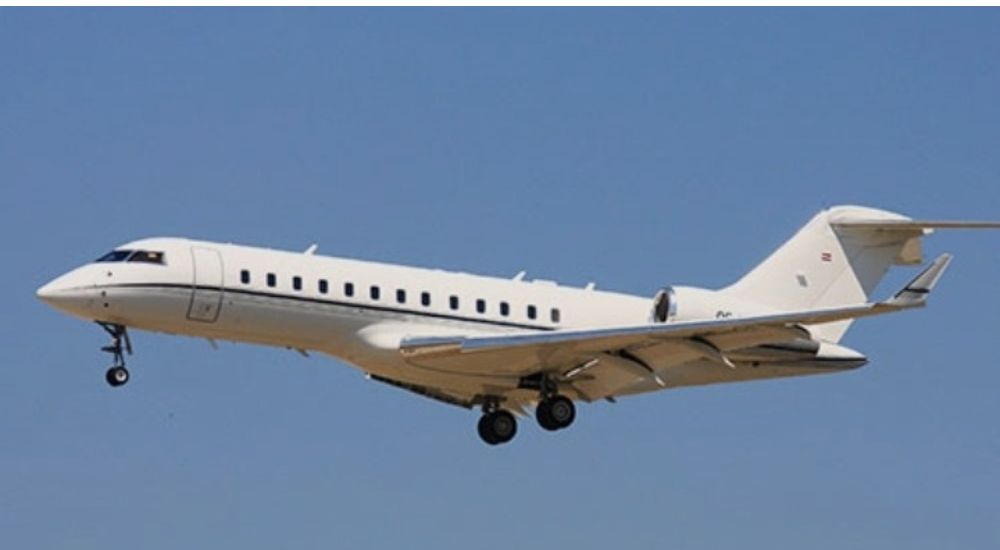
The Federal High Court in Abuja has ordered the final forfeiture of a Bombardier BD-700 Global 6000 private jet, valued at over ₦1 billion, to the Federal Government of Nigeria over unpaid customs duty.
Justice James Omotosho gave the ruling in a suit marked FHC/ABJ/CS/1085/2025, holding that the operators of the aircraft, Orlean Invest Africa Limited, failed to justify why the jet should not be forfeited to the government.
Orlean Investment Holding Limited is owned and controlled by wealthy Italian businessman, Gabrielle Volpi. Volpi is resident in Nigeria with business interests in ports management and other logistics.
His company is believed to be the parent company of Intels which is also a major oil and gas company.
Intels Nigeria Limited is in turn partly owned by former Vice President, Atiku Abubakar.
Abubakar is currently one of the leading opposition leaders in the country hoping to contest the next presidential election with the incumbent President Bola Ahmed Tinubu.
The judgment was delivered on Thursday, while a certified true copy was sighted on Tuesday.
The aircraft, bearing Registration Mark 9H-GVG and Manufacturer’s Serial Number 9470, was imported into Nigeria on October 26, 2015 as a non-commercial private jet. The court found that no customs duty was paid on the aircraft and that no Temporary Import Permit was obtained at the time of importation.
Justice Omotosho ruled that the failure to comply with customs requirements violated the Nigeria Customs Service Act, 2023, which prescribes seizure and forfeiture as penalties under Section 246(a).
He noted that Orlean Invest Africa Limited did not provide any evidence showing payment of customs duty, describing the action as a deliberate attempt to deprive the Federal Government of revenue lawfully due to it.
The Nigeria Customs Service (NCS) assessed the outstanding customs duty on the aircraft at ₦1,044,493,295.54, stating that the jet was brought into the country without the required permits, approvals, or duty payments.
The judge explained that a Temporary Admission Permit should have been secured, alongside an undertaking to re-export the aircraft within an approved period of one to two years, as required by law.
In their defence, the respondents argued that the aircraft was foreign-registered in Malta and operated under international charter by Elit’Avia Malta Ltd. They also claimed that the Nigeria Customs Service Act, 2023 could not be applied retrospectively and cited clearances issued by the Nigerian Civil Aviation Authority (NCAA).
However, Justice Omotosho dismissed the arguments, holding that Section 280(1)-(4) of the Act preserves obligations under the repealed Customs and Excise Act. He also relied on an NCAA circular issued on January 17, 2017, which mandates aircraft owners importing aircraft into Nigeria to obtain customs clearance and pay duties or secure a Temporary Import Permit.
The court found that the respondents failed to comply with the directive and again noted the absence of proof of duty payment.
The case followed an audit exercise conducted by the NCS in 2024 to review the importation compliance of private aircraft operating in Nigerian airspace. The exercise, carried out between June 19 and July 19, 2024, uncovered widespread violations and led to warning notices being issued to affected operators.
Earlier, on June 17, 2025, the court had ordered the interim seizure and detention of the aircraft pending the final determination of the case.
In its final ruling, the court ordered the permanent forfeiture of the aircraft to the Federal Government of Nigeria.
Reacting to the judgment, counsel to the NCS, Mr Okon Efut, SAN, commended the judiciary for enforcing compliance with existing laws, describing the decision as groundbreaking and the first of its kind in Nigeria.