- Safiu Kehinde
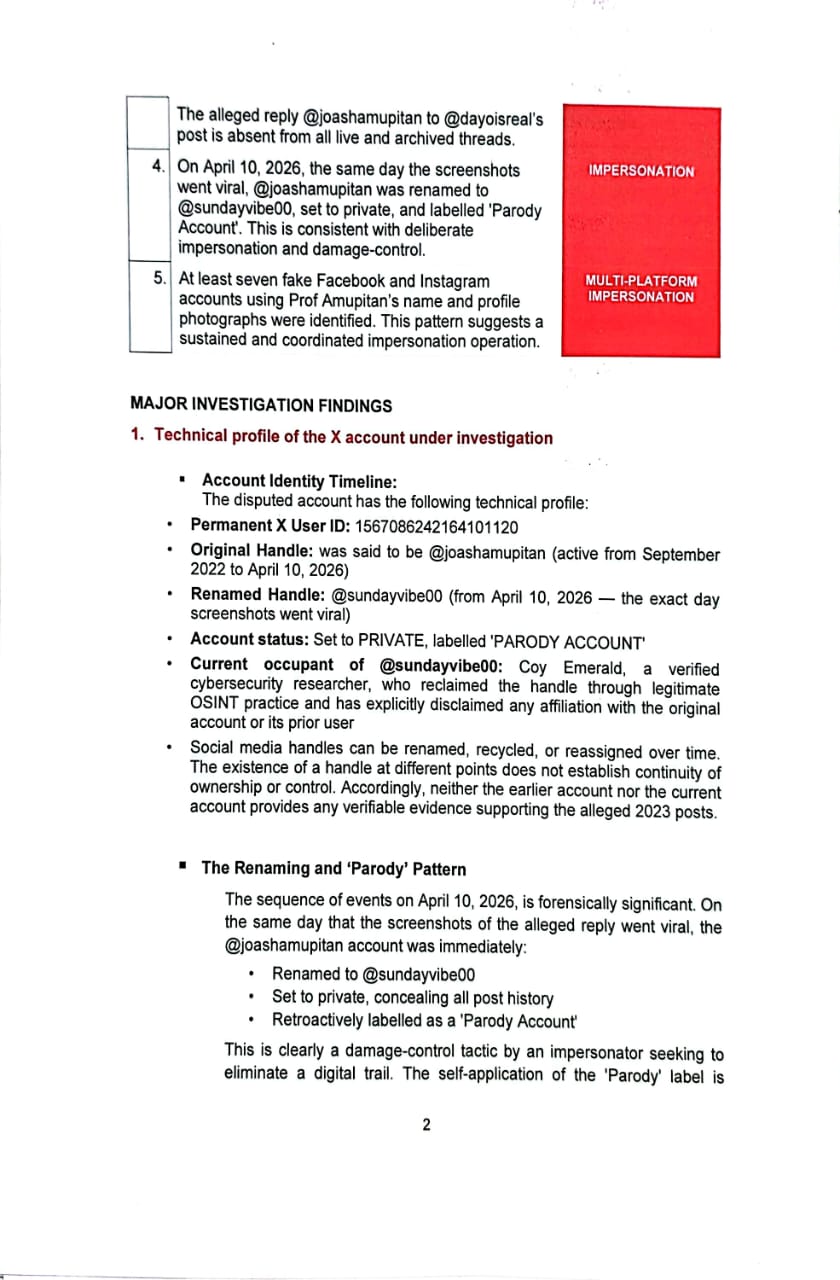
The Independent National Electoral Commission (INEC) has released the forensic findings on the controversial Twitter (now X) account linked to its Chairman, Prof. Joash Amupitan.
NPO Reported that a parody account had earlier this month surfaced on X with claims that the account was originally created by the INEC Chairman.
The account was alleged to previously bear Amupitan’s name before being changed into the account.
This was followed with the circulation of an old post from the account containing a comment under a post by the All Progressives Congress’ (APC) National Youth Leader, Dayo Israel.
The APC National Youth leader had in the post announced securing his polling unit for the party during the 2023 General Election.
Amupitan was alleged to have in the controversial comment typed ‘victory is sure’.
This had reignited calls for his removal over alleged partisanship which contradicts his role as election umpire.
While INEC had since refuted the claims, the commission however embarked on a forensic investigation in a bid to verify the allegations.
The findings of the investigation released on INEC’s official X handle on Monday by its Chief Press Secretary, Adedayo Oketola, revealed that there is no linkage between the X account created in September 2022 and the email address of Amupitan.
The change in the account’s username which now reads @sundayvibe00 was allegedly done by one Coy Emerald, a verified cybersecurity researcher,
On the controversial comment claimed to be evidence of Amupitan’s partisanship, was confirmed to be fabricated.
“Timestamp analysis shows that the alleged 2026 reply ‘victory is sure’ was posted 13 minutes before the original post by Dayo Israel.” The statement from the findings read.
In the same vein, a Wayback Machine searches showed zero records of the X account @joashamupitan, which was later changed to @sundayvibe00, before April 2026.
The findings affirmed that the INEC Chairman was impersonated with the account.
According to the report, seven other Facebook and Instagram account using Amupitan’s name and profile pictures were discovered in what was considered a sustained and coordinated impersonation.
INEC urged members of the public to refrain from circulating unverified screenshots linked to the commission’s officials.
It also charged media organisations to apply strict forensic verification standards to social media posts and screenshots before publishing them.
“The public is encouraged to refrain from sharing, commenting on, or amplifying screenshots allegedly linked to INEC officials unless they have been verified through official channels. Given the exponential rise of generative artificial intelligence, deepfakes, and digital manipulation, screenshots can be easily fabricated using basic image-editing tools.
“The fact that content goes viral does not make it authentic.
“Media organisations, in particular, have a duty to apply strict forensic verification standards to social media posts and screenshots before publishing them, especially when such content implicates public officials or carries serious consequences for public trust and institutional credibility. Accuracy, not speed, must guide reporting in matters of this nature.” The statement read.
INEC further disclosed that the forensic report has been forwarded to law enforcement agency for the tracking of those responsible for the fabrication.
“The independent forensic report has been referred to the law enforcement agencies for necessary action. The law enforcement agencies should move swiftly to trace the origin of the fabricated screenshots, identify the individuals responsible for creating and operating the @joashamupitan account, and prosecute them under Nigeria’s Cybercrimes (Prohibition, Prevention, etc.) Act.
“The law criminalises identity theft, digital forgery, and the dissemination of manipulated electronic content.
“Social media platforms, including X, Meta, and Instagram, must also adopt fast-track impersonation response protocols for verified electoral bodies and senior public officials, whose identities can be exploited to distort democratic processes.” The statement read further.
See full report below