At the start of the year, the M23 seized large parts of eastern DR Congo in an offensive that saw thousands killed and many more forced from their homes.
DR Congo’s President Félix Tshisekedi and his Rwandan counterpart Paul Kagame have frequently exchanged insults in recent years, each accusing the other of starting the conflict.
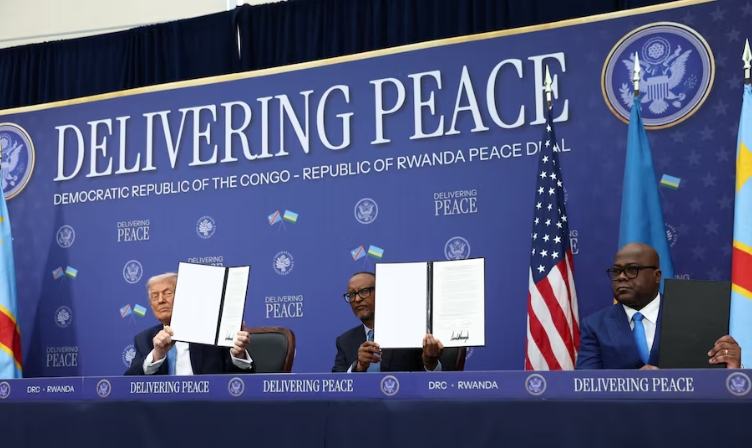
At the signing ceremony on Thursday, there was no public handshake between the pair, whose body language appeared frosty throughout. But this did little to dampen the US president’s rhetoric.
At the beginning of the event at the newly-renamed Donald J Trump Institute of Peace, Trump said the peace ceremony was a “great day” for Africa and the world, later branding it “historic”.
“I have a lot of confidence in both leaders,” Trump added, with journalists noting he had mispronounced the names of both central African presidents. “We’ll keep these commitments. I know they’re going to keep them and follow through on the agreement and create a much brighter future for the people of their countries.”
Trump got the two countries’ foreign ministers to sign a peace accord in June, hailing it as a “glorious triumph”.
A number of other African leaders also attended the ceremony, including those of Kenya, Angola, Burundi and Togo, as well as the vice-president of Uganda.
At the event, Kagame praised Trump as an “even-handed” leader who is “never taking sides”. Rwanda’s president described Trump’s approach as pragmatic and said that “as a result, we have the clearest and most viable path forward that we have ever had”.
Tshisekedi expressed “deep gratitude and clear hope”, while at the same time saying he hoped Rwanda would “respect the letter and spirit of the deal”.
The foreign ministers of Qatar and the UAE also were in attendance at this signing – which Trump has dubbed the “Washington Accords” – as was US Secretary of State Marco Rubio.
However, a day later, Rwandan Foreign Minister Olivier Nduhungirehe told BBC Newsday he would not commit to withdrawing troops from DR Congo, denying that any are there in the first place.
“There is nowhere in any deal that states that Rwanda should withdraw its troops, because we don’t have any troops in eastern DRC,” he said. The deal says all parties should respect national borders and sovereignty and stop supporting armed groups.
UN experts say Rwanda’s army is in “de facto control of M23 operations”.
Nduhungirehe also told the BBC he questioned Congolese commitment to the deal, saying it’s “something that needs to worry the world”.
“It’s as if what the DRC government has signed with its right hand, it doesn’t believe with its heart”, he said, accusing Kinshasa of daily aerial strikes since first agreeing to the deal in June. DR Congo has recently accused Kigali of similar violations, and the UN said Rwandan troops and M23 militia remained on the ground. BBC