

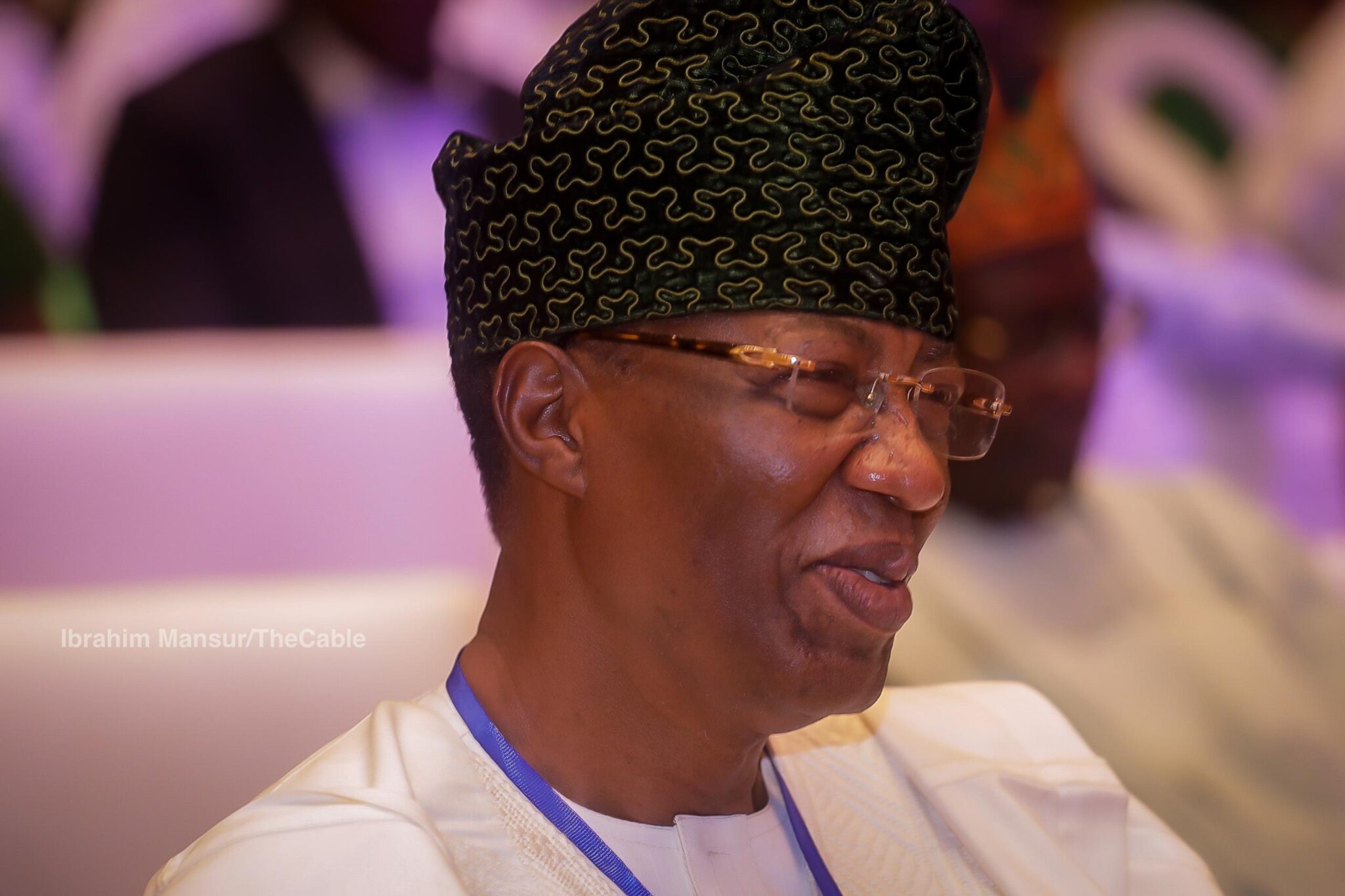
- Safiu Kehinde
Former Ogun State Governor, Sen. Gbenga Daniel, has ruled out chances of Nigeria having a strong economy if the current security challenge facing the country remains unresolved.
Daniel described security and economy as two inseparable variables, stressing that the country cannot have a strong economy without security, and cannot equally have lasting security without a strong economy.
The ex-governor made this known while delivering the preliminary remark at the 7th Freedom Online Yearly Lecture held in Lagos on Thursday.
While acknowledging the recent economic growth in the country, particularly the latest report on the Gross Domestic Product, Daniel maintained that this cannot stand as true test of economic progress if compared to what Nigerians experience daily.
‘Nigeria’s economy has recorded encouraging signs, including growth of 4.43 per cent in the second quarter of 2026, with agriculture and services showing improvement. But the true test of economic progress is not only what appears in GDP figures. It is what Nigerians experience in their daily lives.
‘Can a young person find decent work? Can a farmer safely reach the farm? Can a manufacturer produce competitively?
‘Can a small business survive the cost of power, transport and finance? Can investors commit their resources with confidence?
‘These questions bring us directly to security.’ He said.
Drawing his comparison, the lawmaker representing Ogun East Senatorial District maintained that security is an essential part of economic infrastructure which threatens economic growth if not well managed.
‘Security is not merely a matter for the military, police and other agencies. It is also an essential part of economic infrastructure.
‘When farmers are afraid to cultivate their land, food production suffers. When roads are unsafe, the cost of transporting goods rises.
‘When businesses spend excessively on protection, their competitiveness declines. When communities live in fear, investment is discouraged.
‘The reported abduction of more than 7,800 people between July 2025 and June 2026 is therefore not only a security statistic. It is also an economic warning.’ He said.
Daniel acknowledged the potentials possessed by Nigeria.
He however harped on the need to create the enabling conditions that will allow Nigerians to flourish.
‘But Nigeria must not be defined only by its challenges.
‘We possess enormous potential: a young population, a dynamic entrepreneurial culture, a growing technology sector, strong financial institutions, a vibrant creative economy and businesses succeeding across Africa.
‘Our challenge is to create the conditions in which Nigerian ability can flourish at scale. Those conditions include security, infrastructure and opportunity.’ He said.
Meanwhile, in his address on the economic sector of the country, Daniel identified the oil sector as an important sector of the economy.
He however noted that Nigeria’s future cannot depend on oil alone as he advocated for more investment in the non-oil sector.
‘The non-oil sector accounted for approximately 95.8 per cent of real GDP in the second quarter of 2026, reflecting the growing importance of agriculture, manufacturing, technology, construction, financial services, tourism, entertainment and the digital economy.
‘Our task is to convert these sectors into productive jobs, higher incomes and better living standards.
‘This is especially important for Nigeria’s young people. They need more than speeches. They need skills, employment, access to capital, technology and a society in which enterprise and hard work can lead to a better life.
‘If we give our young people opportunity, they will build Nigeria. If we deny them opportunity, frustration will grow and social stability will suffer.’ He said.
In his concluding remark, the ex-Ogun governor expressed optimism in the country’s future which, according to him, will be determined by decisions made today.
‘The Nigeria we want tomorrow will be determined by the decisions we make today.
‘If we secure our farms, we strengthen food security. If we secure our roads, we strengthen commerce.
‘If we secure our communities, we attract investment. If we create jobs and invest in our young people, we strengthen social stability and the future of the nation.
‘I remain optimistic about Nigeria—not because our problems are small, but because our capacity is greater than our problems.
‘We have the people, the resources, the market and the entrepreneurial spirit. What we need is the security, leadership, infrastructure and discipline to convert potential into prosperity.’ He added.