

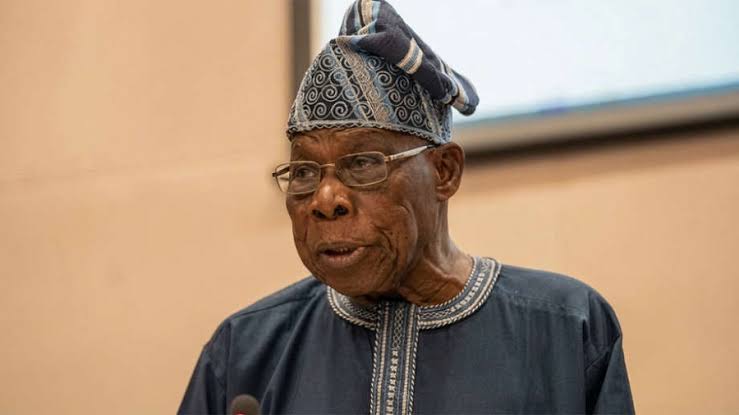
Former President Olusegun Obasanjo has warned against the possibility of Nigeria sliding into another civil war, saying the country still grapples with many of the issues that triggered the 1967 conflict.
The former president spoke on Wednesday while receiving books, research materials, documentary videos and eyewitness accounts documenting the Asaba Massacre from the Chairman of the Asaba Memorial Trust and the Asaba Image Branding and Project Committee, Chuck Nduka-Eze, at the Olusegun Obasanjo Presidential Library.
According to Obasanjo, understanding the mistakes of the past remains essential to preserving Nigeria’s unity.
“What went wrong in the past is essential to preventing a repeat. We must do everything humanly possible to prevent its recurrence,” he said.
Calling on Nigerians to embrace a “never again” resolve, the former president warned that several of the underlying issues that culminated in the Civil War are yet to be fully addressed.
“Some of the things that led to the Civil War are still with us. How long will this remain so?” he asked.
Obasanjo recalled a conversation with former Head of State, Yakubu Gowon, who, according to him, once warned that Nigeria might not survive another civil war.
“I was with a colleague when Gen. Yakubu Gowon said that we would not survive a second civil war as a country. I believe we have fought one civil war too many already.
“To say that we will have a second civil war, God forbid.
“We must understand what happened, condemn what should not have happened, and do everything humanly possible to prevent its recurrence.
“And then, for us to be able to say, ‘never again,’ what are we going to do to make that possible?” he said.
The former president commended Nduka-Eze for preserving the history of the Asaba Massacre.
He noted that one of the core objectives of the Olusegun Obasanjo Presidential Library is to preserve the nation’s past, document its present and inspire future generations.
“We pride ourselves that we preserve the past, we capture the present, and we inspire the future,” he said.
Reflecting on his role during the Nigerian Civil War, Obasanjo acknowledged serving as a military commander but said he could not provide detailed accounts of the Asaba Massacre because military operations in the area were under the command of the late former Head of State, Murtala Mohammed.
He explained that toward the end of the war, he was assigned responsibilities aimed at ensuring further civilian massacres did not occur, stressing that abuses committed by soldiers were never officially condoned.
Obasanjo recounted how he personally stopped a soldier from assaulting a civilian woman in Asaba, noting that commanders bore responsibility for the actions of troops under their control.
He also said Gowon had publicly acknowledged and apologised for excesses committed during the war, maintaining that atrocities such as the Asaba Massacre were neither ordered nor sanctioned by the country’s highest military leadership.
The former president promised to study the documents, interviews and audiovisual materials presented to him, reiterating his commitment to ensuring Nigeria never experiences another civil war.
Presenting the research, Nduka-Eze described the materials as a comprehensive collection of eyewitness testimonies, archival records, documentary evidence, recorded interviews and historical scholarship on the Asaba Massacre.
He said the evidence consistently showed that after federal troops entered Asaba, then a civilian population centre in the Mid-West Region, residents were assembled in public places and instructed to demonstrate loyalty to Nigeria by declaring “One Nigeria.”
According to him, men were subsequently separated from women and children before large numbers of unarmed male civilians were killed.
“The evidence establishes a recurring pattern. Civilians were assembled in public places under conditions of fear and uncertainty. During these assemblies, residents were required to proclaim allegiance to the Nigerian state, including being instructed to declare ‘One Nigeria’ and otherwise demonstrate loyalty.
“In a setting where identity and suspicion had become dangerously intertwined, these acts were understood by those present as affirmations of belonging and safety. Men were then separated from women and children. Thereafter, unarmed male civilians were killed in a manner consistently described across multiple independent accounts,” he said.
Nduka-Eze added that affirming loyalty to Nigeria did not protect the victims, describing the events as one of the country’s darkest moments.
He said although the exact number of casualties remains uncertain, converging historical evidence suggests that more than 1,000 unarmed civilians were killed during the massacre, leaving lasting scars on the Asaba community.
According to him, deep-rooted ethnic suspicion, unresolved grievances following Nigeria’s first military coup and the failure to ensure accountability were among the factors that culminated in both the Asaba Massacre and the Nigerian Civil War.
He warned that many of those underlying issues remain unresolved, with ethnic mistrust continuing to shape relationships among different groups in the country.
Nduka-Eze urged Nigerians to preserve the memory of the Civil War and the Asaba Massacre, saying understanding the nation’s history remains vital to promoting reconciliation, strengthening national unity and ensuring that such a tragedy never happens again.