

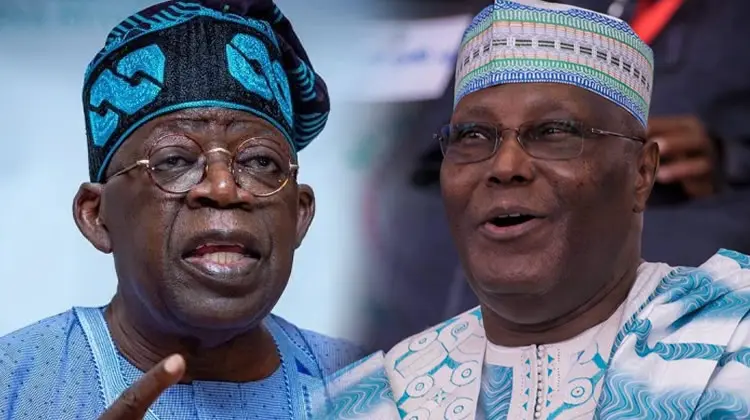
Former Vice President Atiku Abubakar has criticised President Bola Tinubu’s economic policies, arguing that the removal of petrol subsidy and other reforms have worsened the cost-of-living crisis despite increased government revenues.
Atiku, the African Democratic Congress presidential candidate disclosed, in a statement issued on Friday through his Senior Special Assistant on Public Communication, Phrank Shaibu
His comments followed Tinubu’s rejection of his proposal to restore petrol subsidy, with the President describing the former vice president’s position as a demonstration of “serious ignorance on governance and economy.”
NPO Reports recall that Atiku had earlier revealed his plans to restore fuel subsidy if elected president, adding that anyone who had stolen subsidy funds would be made to refund the money.
However, Tinubu, while receiving Osun State Governor Ademola Adeleke at the Presidential Villa in Abuja on Thursday, dismissed the proposal.
Reacting, Atiku said the President was not in a position to lecture Nigerians on economic management, arguing that the administration’s policies had contributed to rising inflation, transportation costs and household expenses.
“The real ignorance is believing suffering is economic policy. Tinubu removed the subsidy from Nigerians’ pockets, but he is yet to remove the questions from his books,” he said.
Atiku clarified that his proposal was not a return to the previous subsidy regime, which he described as open-ended and vulnerable to corruption.
Rather, he said he was proposing a targeted and temporary production-support mechanism aimed at increasing domestic refining capacity and shielding consumers from excessive price shocks.
“Economic prescriptions respond to prevailing conditions. But other things are no longer equal in Tinubu’s Nigeria,” Atiku said.
The former vice president argued that the removal of subsidy in May 2023, without adequate measures to cushion its impact, triggered significant increases in petrol prices, transportation fares and food costs, while the naira also depreciated substantially.
He described his proposed intervention as “a targeted, capped, budgeted, time-bound and independently audited production-support mechanism tied to domestic production and protected against arbitrage.”
Atiku accused the Tinubu administration of taking a rigid approach to subsidy removal despite the economic difficulties that followed.
“Tinubu pronounced first and searched for a plan afterwards. Atiku studied the consequences and produced a solution,” the statement added.
“If subsidy is dead, why are under-recoveries alive?” Atiku asked. “If corruption was eliminated, why has opacity survived?”
He argued that Nigerians were bearing the cost of the reforms through higher petrol prices and living expenses while questions remained over the financial obligations associated with the petroleum sector.
“Tinubu has given Nigerians the worst of both worlds: he removed the relief but retained the opaque costs. Nigerians got the pain; government kept the bill,” he said.